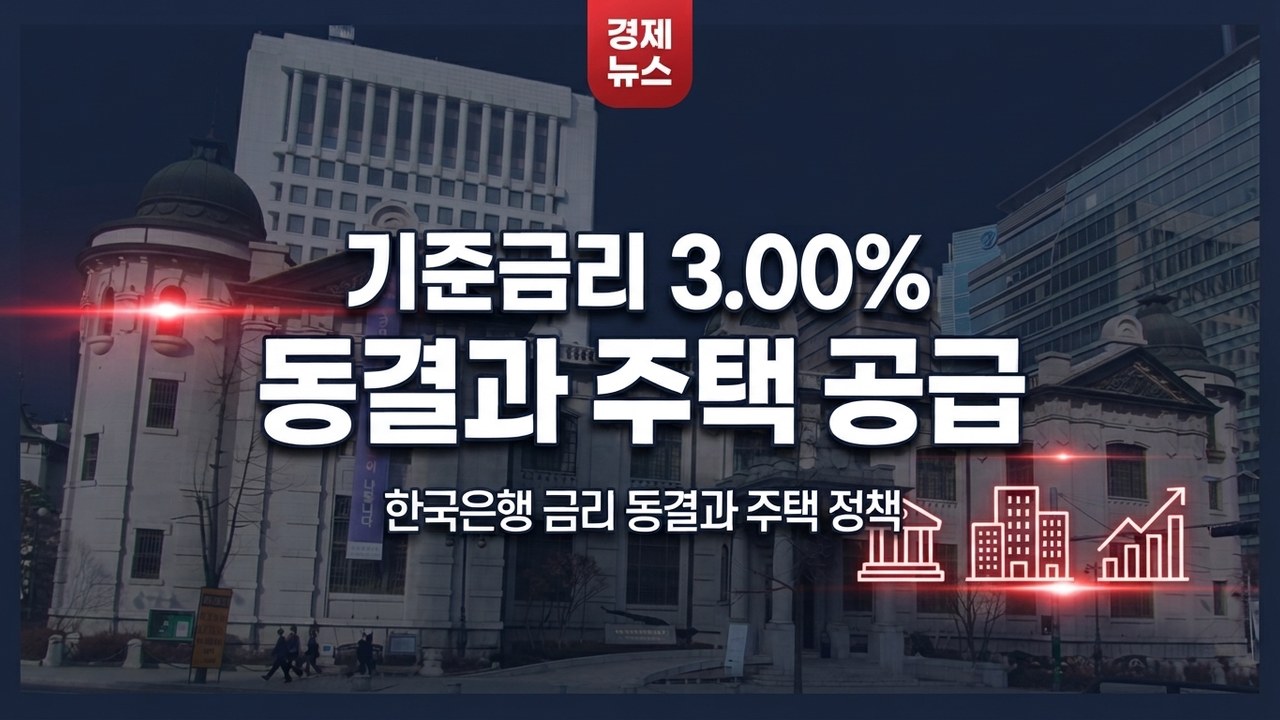
Bank of Korea rate hold in 2026 housing supply impact
📌 Topic & Subject
This article examines the Bank of Korea's decision in October 2026 to hold its benchmark interest rate at 3.00% under Governor Hyun-Song Shin. It discusses the broader economic context, including President Lee Jae-myung's push for accelerated metropolitan housing supply, rising household debt, strong export performance from AI chips, and the interplay between monetary tightening and fiscal stimulus.
📌 Table of Contents
- 1. Executive overview of the policy standstill
- 2. Institutional positions and policy friction
- 3. Macroeconomic drivers behind the decision
- 4. Asset inflation and debt distribution data
- 5. Supply expansion versus credit suppression
- 6. Historical rate cycles and policy divergence
- 7. Strategic matrix of economic variables
- 8. Practical steps for household borrowers
- 9. Outlook for rates and market risks
- 10. Actionable checklist for navigating the hawkish pause
On October 22, 2026, Governor Hyun-Song Shin walked into the Bank of Korea headquarters in Jung-gu, Seoul, under the glare of camera flashes. The Monetary Policy Board held the seven-day repurchase rate at approximately 3.00%. This pause followed consecutive rate hikes in July and August. The decision marks a critical test for the dual approach of credit curbs and state housing drives.

The central bank faced a complex economic backdrop. A boom in artificial intelligence chips lifted growth forecasts. At the same time, Seoul apartment prices climbed for 88 consecutive weeks. President Lee Jae-myung reportedly ordered emergency measures to accelerate housing projects. The policy standstill gives officials time to gauge financial risks.

Executive overview of the policy standstill
The Monetary Policy Board maintained the benchmark rate at 3.00% during its scheduled session. The hold followed consecutive 25-basis-point rate increases in July and August. The benchmark previously moved from 2.50% to 2.75%, then reached 3.00%. Policymakers chose an operational pause to inspect transmission channels. Restraint took priority over aggressive action.
Historical precedent reveals how rare rapid hikes remain. The Bank of Korea executed three or more back-to-back rate increases only once in recent history. That cycle occurred during the inflation surge of 2022 and 2023. Back then, consumer price index gains exceeded 6.0%. Current economic conditions display contrasting dynamics. Inflation slowed while asset values remained firm.
Headline consumer price growth reportedly cooled to 2.9% year-on-year in September. That reading was down from 3.1% in August. Core inflation, which excludes agricultural items and oil, reportedly fell from 3.4% to 2.8%. Yet household leverage expanded at commercial lenders. Central bankers balanced growth against property market pressures.
Institutional positions and policy friction
Friction between monetary discipline and fiscal stimulus defined the decision. President Lee pressed ministries to remove red tape for residential construction. Governor Shin maintained that credit controls must remain tight. The administration seeks supply expansion while the central bank guards loan quality. Both entities monitor speculative activity across metropolitan zones.
| Institution / Leader | Core Stance | Key Statement or Action | Policy Objective |
|---|---|---|---|
| Hyun-Song Shin (Bank of Korea Governor) | Hawkish pause | Stated prior hikes bought time; urged early response to avoid larger corrections | Curb asset bubbles and restrain household borrowing expansion |
| Lee Jae-myung (President of South Korea) | Aggressive supply push | Ordered rapid approvals and cited market projections of 3.50% terminal rates | Expand metropolitan housing stock and eliminate property speculation |
| Lee Hyoung-il (Deputy Prime Minister) | Macroprudential coordination | Cut October bond issuance by ₩5 trillion (about $3.76 billion) to stabilize yields | Support 3.4%–3.6% gross domestic product growth targets |
| Market Economists (Reuters / Yonhap Polls) | Unanimous hold forecast | All 34 surveyed economists projected the rate would remain at 3.00% in October | Anticipate possible policy resumption in November or early 2027 |
Macroeconomic drivers behind the decision
External trade created massive revenue inflows for Korean exporters. According to central bank data, the cumulative current account surplus reportedly reached $279.2 billion from January to August 2026. That total roughly quadrupled the $70 billion surplus logged during the same period in 2025. Semiconductor shipments sustained this surplus. Global technology investments drove the revenue expansion.
Gross domestic product projections shifted upward as a result. Both Morgan Stanley and the Ministry of Economy and Finance adjusted their 2026 growth forecasts to a band of 3.4%–3.6%. That rate exceeds South Korea’s estimated potential growth rate. Rapid growth often introduces demand-side inflationary forces. Central bankers monitored these developments carefully.
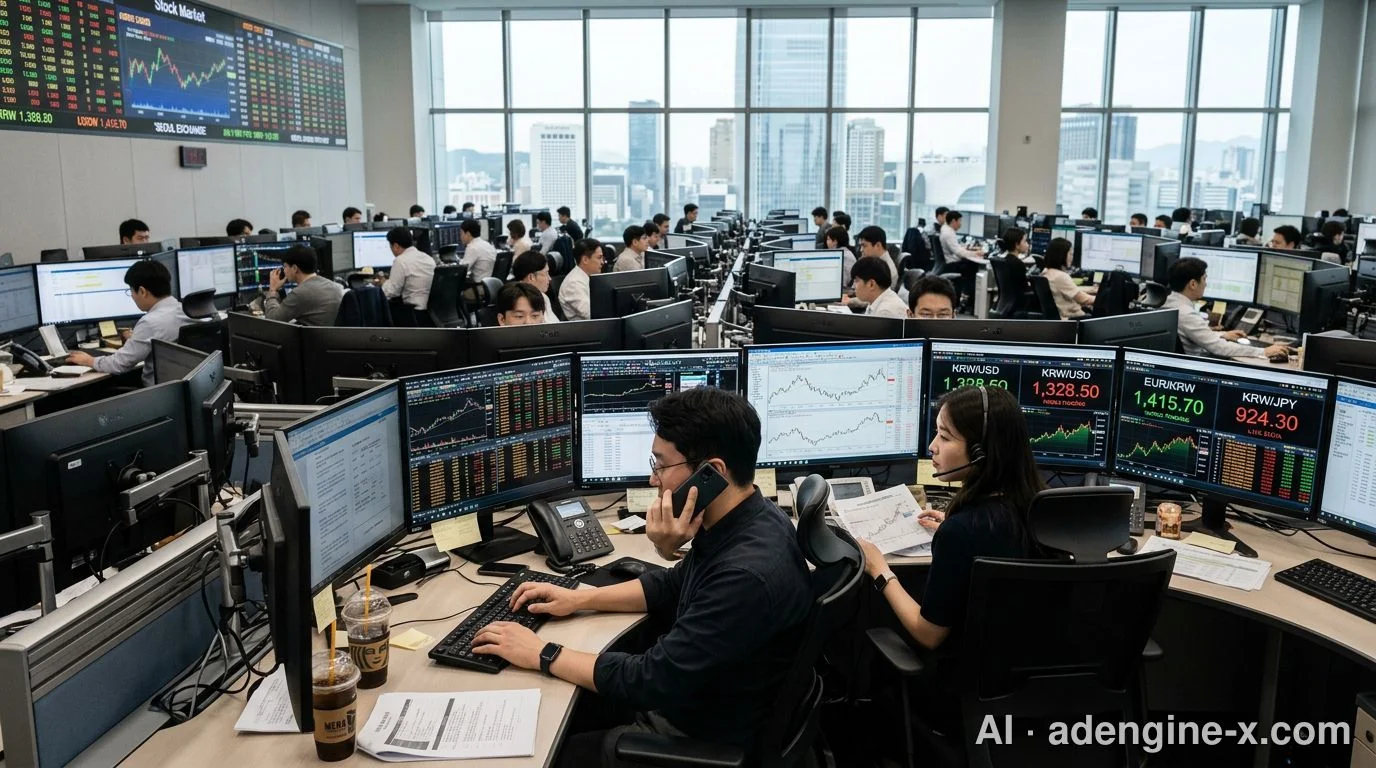
Foreign exchange flows also affected monetary conditions. Heavy corporate dollar selling pushed the won into the lower 1,330 range against the US dollar. That level represented the strongest value for the local currency in two years. However, imported commodity risks lingered. Brent crude futures fluctuated between $106 and $112 per barrel amid Middle East friction.
Asset inflation and debt distribution data
Domestic real estate remained resilient against previous monetary tightening. The Korea Real Estate Board reportedly indicated that Seoul apartment sale prices climbed for 88 weeks in a row. Mortgage demand followed this upward trend. Borrowers reportedly sought property across central districts despite higher borrowing expenses.
Household lending across the five largest commercial banks reportedly surged. KB Kookmin, Shinhan, Hana, Woori, and NH NongHyup posted a combined monthly loan increase of ₩2.7643 trillion (about $2.1 billion). Private leverage accumulated rapidly. Financial regulators reacted by enforcing stricter debt qualification metrics.
Capital allocation patterns inside households altered significantly. Bank of Korea flow of funds accounts showed that household equity assets reached ₩1,790.7 trillion (about $1.35 trillion) as of the end of June 2026. That sum equaled 25.8% of all domestic household financial holdings. This proportion reportedly marked an all-time record. High retail equity engagement created wealth effects across urban centers.
Supply expansion versus credit suppression
The policy debate centers on structural timing differences. Monetary policy works as a blunt credit suppression mechanism. Raising interest rates curbs overall liquidity and elevates borrowing friction. Yet higher rates penalize construction firms. Development project financing becomes vulnerable to cash flow shortfalls under elevated interest rates.
Physical supply programs require significant lead time. Land assembly, foundation preparation, and construction demand two to three years before occupancy. President Lee reportedly attempted to compress administrative phases. Authority for projects under 500 units moved to district chiefs. That shift cut bureaucratic review timelines from 18 months down to between six and nine months.

A pincer strategy formed between the administration and the central bank. Short-term debt caps restrain immediate purchasing power. Long-term approvals aim to alleviate urban housing deficits. If the policy balance tips too far toward restriction, builder insolvencies could rise. If it tilts toward excessive liquidity, housing costs could escalate again.
Historical rate cycles and policy divergence
Central bank authorities examined the precedent set during the post-pandemic cycle. Between 2021 and early 2023, the Monetary Policy Board raised rates from 0.50% to 3.50%. That campaign included an unprecedented run of seven consecutive rate hikes. The current macroeconomic backdrop differs markedly. The present environment combines export gains with domestic consumer caution.
Bond market volatility also demanded immediate stabilization. The yield on the 10-year Korea Treasury Bond surged to 4.54% in late September. Yields moderated toward 4.25% by mid-October. This correction followed the government’s decision to reduce planned October bond sales by ₩5 trillion (about $3.76 billion). Treasury officials intervened to prevent corporate borrowing costs from breaking annual thresholds.

International central bank divergence influenced domestic calculations. The US Federal Reserve maintained elevated benchmark costs to suppress sticky service sector inflation. An excessive gap between Seoul and Washington could disrupt cross-border capital flows. The Bank of Korea guarded against currency weakness while preventing sudden domestic demand contraction.
Strategic matrix of economic variables
The following table outlines the analytical metrics governing financial choices across South Korea as of October 2026.
| Macro Indicator | Current Reading | Prior Trend / Baseline | Implication for Rates |
|---|---|---|---|
| Base Rate | 3.00% | 2.50% (June 2026) | Policy pause to evaluate cumulative transmission |
| Headline CPI | 2.9% (September) | 3.1% (August) | Reduced immediate urgency for consecutive tightening |
| Core Inflation | 2.8% (September) | 3.4% (August) | Underlying cost pressure showing moderation |
| 10-Year Bond Yield | 4.25% | 4.54% (Late September) | Issuance reductions calmed fixed-income spikes |
| GDP Growth Forecast | 3.4%–3.6% | 2.2% (Initial baseline) | Strong output provides cushion for future tightening |
| Seoul Housing Trend | 88 weeks positive | Sustained momentum | Remains the primary trigger for a potential 3.25% hike |
Practical steps for household borrowers
Household borrowers and property buyers must navigate evolving financing limits and changing interest rates. You can recalibrate debt exposure and adjust application timelines within two weeks. Specific conditions are subject to individual recruitment notices, financial institution screenings, and official announcements.
1. Audit existing variable rate exposure
Check the benchmark index on your outstanding credit lines. Many Korean housing loans tie their repayment schedules to the six-month cost of funds index. If the central bank resumes rate hikes in November or early 2027, borrowing costs will rise. Five-year fixed and periodic rate products at major domestic lenders carry rates between 4.82% and 7.24% (as of October 2026). Switching to a five-year fixed structure protects monthly budgets.
2. Calculate limits under stress debt ratios
Review your maximum borrowing capacity under stricter underwriting rules. Regulators added add-on interest rates under the enhanced stress debt service ratio rules. This regulatory change directly reduces loan caps for floating contracts. Run calculations through your bank branch before signing binding property purchase agreements. Securing pre-approval prevents closing delays.
3. Track fast-track urban housing allotments
Monitor municipal releases for small-scale residential developments. District approvals for infill projects under 500 units now process within nine months. Public portals from state housing bodies publish monthly construction timetables. Buyers seeking primary residences can find lower entry costs in transit-adjacent projects before private inventory arrives.
4. Rebalance long-term sovereign bond allocations
Examine 10-year Treasury yields when market pricing trades above 4.20%. Locking in sovereign yields at elevated entry points provides steady income. Capital appreciation also develops when the Monetary Policy Board eventually enters an easing cycle. Avoid high-leverage property purchases in peripheral regions with soft auction winning rates.
Outlook for rates and market risks
The policy pause does not necessarily mean tightening has ended. Forward-guidance indicators from the central bank show multiple board members favor further rate hikes. During its August 2026 proceedings, 10 out of 21 dots pointed toward a 3.25% rate benchmark within six months. If metropolitan housing prices continue their streak, a rate hike remains probable.
Emergency administrative mechanisms provide a safety net against downside shocks. The government prepared a public acquisition framework to absorb distressed homes if interest costs surge unexpectedly. State entities plan to buy discounted auction inventory and convert those units into long-term rentals. This backstop shields the broader financial structure from systemic defaults.
Bottom line: Expect high borrowing costs to persist while accelerated building permits take years to translate into physical home completions.
Actionable checklist for navigating the hawkish pause
To navigate this extended policy pause, align your financial strategy with persistent restrictive pressures:
- Assess mortgage exposure: Lock in fixed structures, which ranged between 4.82% and 7.24% as of October 2026, before benchmark rates potentially climb toward 3.5%.
- Verify stress debt limits: Recalculate lending ceilings under tightened underwriting standards prior to bidding on real estate.
- Track expedited supply: Monitor municipal portals for fast-tracked urban projects to locate competitive entry points.
ℹ️ This article was drafted with the help of an AI tool and reviewed/edited by a human before publishing. · Original: AdEngine-X

Apple Price Hikes 2026: Why Memory Costs Are Surging
🇺🇸 English (영어) · 마샬팀장 · 9/23/2026

Mortgage Rates Today (September 8, 2026): What the Post-Holiday Dip Means for Homebuyers and Investors
🇺🇸 English (영어) · 마샬팀장 · 9/8/2026

George Clooney: 7 Strategic Metrics, Box Office Benchmarks, and Complete Career Spec Analysis
🇺🇸 English (영어) · Lifestyle Desk · 9/3/2026
China's $19,170 Electric Vehicle: Inside Geely Galaxy TT Specs, Price War, and Global Impact
🇺🇸 English (영어) · 마샬팀장 · 9/13/2026
More from this author




🗞️ Source material
- Bank of Korea holds rates after President Lee calls for boosting housing supply— Ref: CNBC (headline & link)
This article was independently written and edited by AdEngine-X based on the facts reported in the sources below. No original wording or photos were used.
📚 References
This list may include both live search sources the AI referenced while writing and public-data sources checked during fact verification. Please verify the original sources before citing or reusing.
0 Comments
Loading comments...