UAE economy how to interpret the IMF upgrade
📌 Topic & Subject
This article explains how to interpret the IMF's upward revision of the United Arab Emirates' economic growth forecast for 2026. It analyzes specific metrics such as real GDP, inflation estimates, and banking-sector assets, while distinguishing macroeconomic improvements from individual household costs and business conditions.
📌 Table of Contents
- 1. Separate the upgrade from a boom
- 2. Trace the recovery to its causes
- 3. Compare the figures by date
- 4. Translate the outlook into household decisions
- 5. Test the rebound against its assumptions
- 6. Follow the next releases and dates
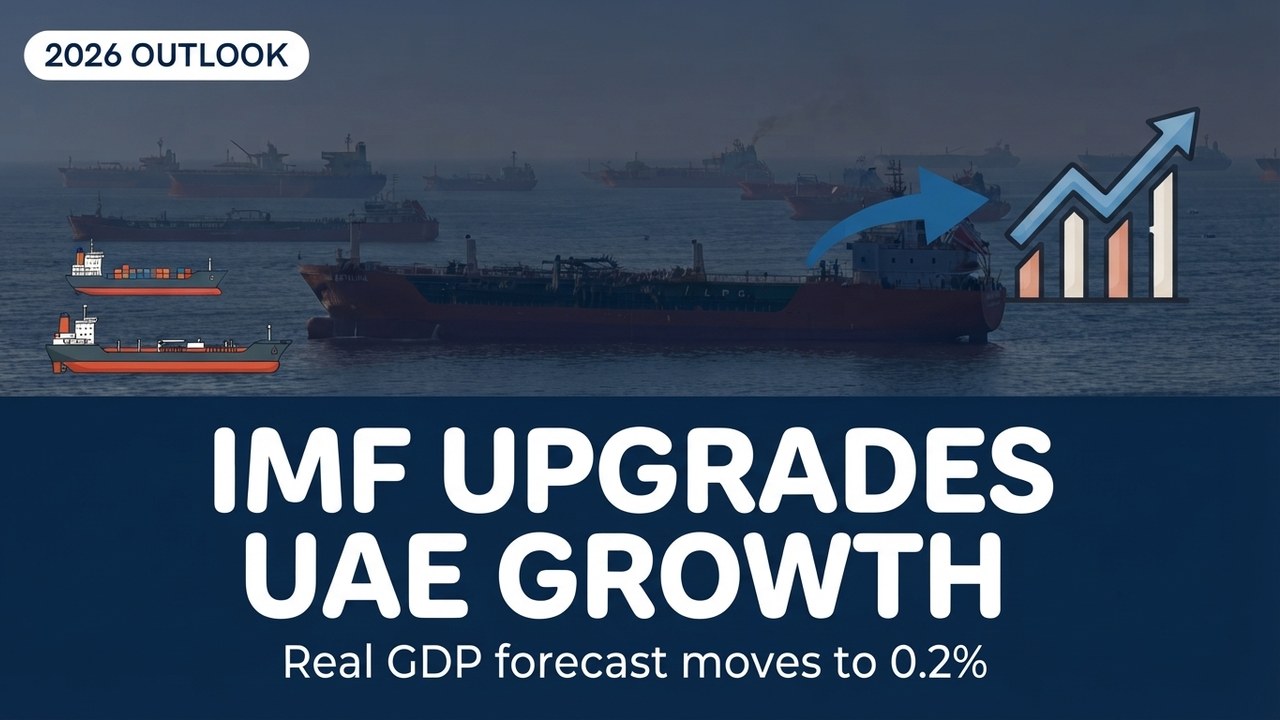
The IMF raised its forecast for UAE economic growth in November 2026 to 0.2%, reversing October’s projection of a 3.9% contraction. In a November CNBC interview, Economy and Tourism Minister Abdulla bin Touq Al Marri expressed confidence in the country’s resilience. For households and investors, the distinction matters: avoiding a contraction does not mean living costs or business conditions have returned to normal.
1. Separate the upgrade from a boom
Read the IMF revision as an improvement in the expected outcome, not confirmation of strong growth already achieved. The November forecast represents a 4.1-percentage-point increase from October. Yet projected real GDP growth of 0.2% still describes an economy expanding only slightly over the full year.
Real GDP measures economic output after adjusting for price changes. It does not measure whether a particular family’s purchasing power improved, whether wages rose, or whether every business recovered. Those outcomes can diverge from the national total.
According to CNBC’s November 2026 interview, Al Marri expected the final growth result to exceed the IMF’s revised forecast. He also expressed optimism about growth of 7%–8% in 2027. Those are government expectations, not completed economic results.
The immediate news: The IMF no longer projected a full-year UAE contraction in its November assessment.
The important limit: The 0.2% figure remained a forecast, rather than the final 2026 GDP result.
The household implication: A better national outlook does not automatically lower grocery bills, borrowing costs, or airfares.
2. Trace the recovery to its causes
Trace the forecast change to the interaction between regional disruption and the UAE’s capacity to absorb it. Conflict intensified in the Middle East during early 2026, while insecurity around the Strait of Hormuz disrupted maritime activity. Trade interruptions and uncertainty over export routes weighed on the economic outlook.

The October IMF forecast reflected those pressures. By November, alternative oil transportation arrangements and resilience outside the oil sector supported a less negative assessment. The revision reflected improving conditions, rather than the disappearance of regional security risks.
Public buffers supported the response
The IMF’s July and November 2026 statements emphasized rapid policy measures, substantial public and external financial buffers, and well-capitalized banks. These resources can help an economy absorb interruptions and maintain financial activity. They do not prevent individual companies or households from experiencing losses.
The World Bank’s October 2026 assessment identified renewed oil production and exports as recovery drivers. It also pointed to tourism, trade, financial services, and construction. Its central qualification was that the recovery’s strength would depend heavily on regional security conditions.
Tourism improved before risks disappeared
Al Marri cited resumed services by British Airways and Air France, alongside alternative flight routes, in his November CNBC interview. He said hotel occupancy had approached normal levels. That supports the case for improving tourism activity, but it does not establish that every route or travel cost had normalized.
The government is also emphasizing domestic manufacturing capacity and more resilient supply chains. The aim is to improve access to essential goods during disruption. This is a longer-term policy direction, not proof that domestic production has already removed reliance on imported supplies.

3. Compare the figures by date
Compare each number with its reference period and status before drawing conclusions. An annual forecast, a government target, and a banking-sector balance-sheet total answer different questions. None should be treated as interchangeable evidence of household prosperity.
Indicator | Figure | Source and reference date | How to interpret it |
|---|---|---|---|
Previous 2026 real GDP forecast | −3.9% | IMF, October 2026 | The earlier projection anticipated a full-year contraction. |
Revised 2026 real GDP forecast | +0.2% | IMF, November 2026 | A 4.1-percentage-point upward revision, but only slight projected growth. |
2027 real GDP growth forecast | 7.3% | IMF, November 2026 | A projected rebound dependent on improving regional conditions. |
Government’s 2027 growth expectation | 7%–8% | UAE economy minister, CNBC interview, November 2026 | An expression of government expectations, not an achieved result. |
2026 annual average consumer inflation estimate | About 5.0% | IMF, November 2026 | An annual estimate, not the latest monthly inflation reading. |
2027 annual average consumer inflation forecast | About 3.0% | IMF, November 2026 | Slower expected price increases, not a forecast of falling prices. |
UAE banking-sector total assets | More than AED 5.8 trillion | Central Bank of the UAE, end of Q3 2026 (cited at the IMF mission’s closing meeting, November 18, 2026) | A measure of sector size, not a guarantee covering individual deposits or investments. |
Keep the units straight: The GDP revision is measured in percentage points. Inflation measures price changes, while banking assets measure a stock of financial assets. Comparing their numerical sizes would not reveal which risk matters most to a household.
4. Translate the outlook into household decisions
Translate the economic news into questions about your own costs and commitments. A national recovery can support business activity while imported goods, travel, and housing remain expensive. The practical task is to identify where your budget remains exposed.
Build budgets around actual bills
The IMF’s November 2026 inflation estimate of about 5% for 2026 signals continuing price pressure. Its forecast of about 3% for 2027 implies slower increases, not a reversal of previous increases. Your household’s experience will depend on its spending mix.

Groceries and essentials: Compare recent receipts rather than applying the national inflation rate equally to every purchase.
Large expenses: Use current written quotes for planned purchases instead of assuming stronger GDP will make them cheaper.
Emergency savings: Recalculate essential monthly spending before deciding whether your existing reserve still meets your needs.
Distinguish flight availability from travel certainty
Resumed airline services are encouraging, but regional airspace changes can still affect journey times and connections. Before booking family travel, review the operating route, change conditions, and refund terms. Check insurance exclusions directly with the insurer; disruption coverage depends on the policy.
Separate bank strength from personal protection
The IMF’s favorable assessment of bank capitalization supports confidence in system resilience. However, total assets alone cannot establish the safety of a particular account, investment, or financial institution. Review the applicable terms and protections with the relevant bank or regulator.
For borrowing, distinguish the advertised rate from the payment obligations in your agreement. Any refinancing or new borrowing decision depends on eligibility, fees, contractual terms, and the lender’s assessment. The GDP upgrade itself does not determine your borrowing rate.
Evaluate investments below the national level
For investors, stronger economic growth can improve demand without improving every company’s earnings. Financing costs, transport expenses, insurance costs, and existing asset prices still matter. A favorable national forecast is therefore not a sufficient basis for selecting an investment.
Assess exposure to tourism, trade, construction, and oil separately. Consider how interruptions would affect revenue, cash flow, and debt payments. This is a framework for evaluating risk, not a recommendation to buy or sell any security or product.
5. Test the rebound against its assumptions
Test the IMF’s November 2026 forecast of 7.3% growth in 2027 against the conditions needed to support it. The projected rebound assumes easing regional conflict and more normal trade routes, including around the Strait of Hormuz. It should not be read as an unconditional outcome.
Evidence supporting recovery: The World Bank’s October assessment identified recovering oil exports and activity across several non-oil industries.
Evidence supporting resilience: The IMF highlighted policy responsiveness, financial buffers, and bank capitalization in its 2026 assessments.
Evidence of continuing vulnerability: The IMF warned that renewed escalation, intermittent Strait closures, and supply-chain disruption could delay recovery and increase inflation.
A strong annual rebound can also partly reflect comparison with a weak preceding year. That arithmetic does not make the recovery meaningless. It does mean readers should examine output levels and sector performance alongside headline growth rates.
The most important unresolved questions concern the duration of regional disruption and the pace of normalization. Oil production can recover while shipping insurance and security costs remain elevated. Those costs can continue reaching consumers even when national GDP returns to growth.
The minister’s optimism and the IMF’s caution therefore address different aspects of the same outlook. The UAE may have substantial capacity to withstand shocks while remaining exposed to further disruption. Resilience reduces vulnerability; it does not eliminate uncertainty.
6. Follow the next releases and dates
Follow the next official releases for evidence that recovery is reaching output, prices, and business activity. As of November 25, 2026, the following events and publication windows were expected. Scheduled events and release timing can change.
IMF Executive Board review (date not yet announced): Subject to IMF management approval, the staff report from the November 2026 Article IV mission will go to the IMF Executive Board for discussion. The Board concluded its previous Article IV consultation with the UAE on December 1, 2025. Watch for the approved assessment, forecast assumptions, and financial-sector analysis.
Early 2027: UAE annual GDP and inflation releases are expected to clarify the 2026 outcome. Check each release’s stated status and subsequent revisions.
Next IMF outlook update: Consult the IMF publication calendar for the announced release date and any changes to UAE forecasts.
Between those releases, prioritize consumer inflation, oil production and exports, flight operations, and shipping conditions. Where published, sector-level activity can show whether improvement is broadening beyond the headline GDP figure. Keep annual averages separate from monthly readings.
The upgrade makes the UAE’s outlook less negative, but household relief still depends on prices, income, and uninterrupted services. The next releases will test whether the expected recovery is becoming sustained growth. Start by updating your essential-spending budget using your latest bills.
Sources: IMF staff statement on the 2026 Article IV mission to the UAE (November 18, 2026); IMF staff visit statement (July 17, 2026); Central Bank of the UAE release on the IMF mission, including banking-sector assets (November 18, 2026); CNBC interview with Minister Abdulla bin Touq Al Marri (November 25, 2026); World Bank Macro Poverty Outlook for the UAE (October 2026).
ℹ️ This article was written with the help of AI tools. · Original: AdEngine-X

Airline seat volume and yield focus operational differences
🇺🇸 English (영어) · 마샬팀장 · 10/25/2026

US Iran carrier risks explained for household investors
🇺🇸 English (영어) · Politics & Security Desk · 11/17/2026

AI spending fears 5 rules for household investors
🇺🇸 English (영어) · 마샬팀장 · 10/23/2026

US airlines first class exit explained in 6 changes
🇺🇸 English (영어) · 마샬팀장 · 11/23/2026
More from this author




🗞️ Source material
- ‘Ready for any storm’: UAE minister optimistic on economy as IMF lifts forecast— Ref: CNBC (headline & link)
This article was independently written and edited by AdEngine-X based on the facts reported in the sources below. No original wording or photos were used.
📚 References
- tradersunion.com
- arabianbusiness.com
- imf.org
- thenationalfinance.ae
- enterpriseam.com
- peoplemattersglobal.com
This list may include both live search sources the AI referenced while writing and public-data sources checked during fact verification. Please verify the original sources before citing or reusing.
Was this article helpful?
0 Comments
Loading comments...