NFL Schedule Explained: Engineering Formula, Streaming Costs, and 3-Night Travel Strategy
(Advertisers wanted)
(Advertisers wanted)
📌 Topic & Subject
This article explores the operational and mathematical mechanics behind the NFL regular season schedule. It details the 17-game opponent rotation formula, the cloud computing infrastructure and algorithms used for temporal and broadcast allocation, and the structural constraints involved in managing team travel and stadium usage.
(Advertisers wanted)
(Advertisers wanted)
📌 Table of Contents
- 1. Overview and Structural Significance of the NFL Regular Season Schedule
- 2. Core Technical Specifications: The NFL Scheduling Matrix
- 3. Mathematical Derivation: The 17-Game Opponent Rotation Formula
- 4. Computational Optimization: The Engineering Behind Schedule Creation
- 5. Media Economics, Broadcast Windows, and Streaming Friction
- 6. Competitive Disparities: Rest Inequity and Travel Logistics
- 7. Step-by-Step Practical Implementation Guide: A 3-Night, 4-Day NFL Travel Playbook
- 8. Critical Vulnerabilities, Pitfalls, and Flexible Scheduling Traps
- 9. Strategic Outlook: An 18-Game Regular Season and the Global Era
- 10. Frequently Asked Questions (FAQ)
1. Overview and Structural Significance of the NFL Regular Season Schedule
The National Football League (NFL) regular season schedule represents one of the most sophisticated optimization and logistical operations in the global sports entertainment economy. Dictating approximately 272 games contested across an 18-week operational calendar by 32 franchises, the schedule operates not merely as a sequential fixture list, but as an algorithmic clearinghouse for media rights contracts valued at approximately $10 billion annually (around $110 billion across the 2023–2033 broadcast cycle). Every single fixture accounts for approximately 5.88% of a team's total regular-season campaign—a scarcity premium that makes each matchup an enterprise-level event compared to high-volume leagues such as Major League Baseball (162 games, 0.62% per game) or the National Basketball Association (82 games, 1.22% per game).
The structural framework of the modern schedule trace back across foundational evolutionary milestones. Following the 1961 adoption of a standardized 14-game slate and the subsequent 1970 AFL-NFL merger, the league expanded to a 16-game, 16-week model in 1978. In 1990, the introduction of a designated bye week expanded the calendar footprint to 17 weeks without adding on-field games. The latest fundamental paradigm shift reportedly occurred ahead of the 2021 campaign under the ratified NFL-NFLPA Collective Bargaining Agreement (CBA), establishing the current 17-game, 18-week architecture. This modification systematically expanded total inventory from 256 to 272 games, eliminated one preseason fixture (reducing the exhibition phase from four games to three), and introduced structural asymmetries across competitive balance, travel volume, and media window assignments.
From an analytical standpoint, the architecture of the NFL schedule is strictly bifurcated into two distinct operational layers:
- Matchup Determination (Opponent Pairing): Governed by a closed, deterministic mathematical rotation formula that settles a team's 17 designated opponents mechanically the moment the final whistle blows in Week 18.
- Temporal and Broadcast Allocation (Date, Time, and Network Placement): A variable, high-complexity optimization puzzle solved between January and mid-May using cloud computing clusters and integer programming solvers to align competitive fairness with network contract obligations.
The Dual-Phase Architecture: Formulaic Certainty vs. Computational Combinatorics
While fans often anticipate the mid-May "NFL Schedule Release" as an unpredictable lottery, 100% of the matchups are predetermined years or months in advance. The unpredictability belongs entirely to the placement phase. The league's broadcasting department must map those 272 designated matchups across 576 potential kickoff windows while respecting over 26,000 linear mathematical constraints. These variables encompass stadium availability, local municipal ordinances, travel fatigue vectors, network selection tiers, minimum rest intervals, and cross-flexing protocols. Consequently, evaluating the NFL schedule requires isolating the fixed mathematical equations of opponent matrix allocation from the multi-objective computing models that sequence them onto the calendar.
2. Core Technical Specifications: The NFL Scheduling Matrix
To quantify the structural properties of the NFL calendar, the following specification table contrasts the current 17-game configuration with previous standards and competing North American sports leagues, alongside verified media valuations and regulatory constraints.
| Metric / Operational Parameter | NFL (Current 17-Game Format) | Historical NFL (16-Game Format) | MLB Comparison | NBA / NHL Comparison |
|---|---|---|---|---|
| Regular Season Volume | 17 Games / 18 Weeks (272 Total) | 16 Games / 17 Weeks (256 Total) | 162 Games / ~26 Weeks | 82 Games / ~24–25 Weeks |
| Single-Game Season Weight | 5.88% | 6.25% | 0.62% | 1.22% |
| Home/Away Split Balance | Asymmetric: 9 Home / 8 Away (Rotates by Conference yearly) | Symmetric: 8 Home / 8 Away | Symmetric: 81 Home / 81 Away | Symmetric: 41 Home / 41 Away |
| Optimization Engine Architecture | AWS Cloud (3,000–5,000 EC2 instances), Gurobi Mixed-Integer Linear Programming | Physical corkboards, local mainframe, basic linear solver scripts | Balanced series-based schedule optimization | Arena matrix integer programming |
| Annual Media Distribution Value | $10B+ / yr (ESPN $2.7B, FOX $2.25B, CBS $2.1B, NBC $2B, Amazon $1B, YouTube $2B) | ~$5B–$7B / yr across standard broadcast tiers | ~$1.8B / yr national + regional cable networks | ~$2.7B / yr (historical national baseline) |
| Mandated Minimum Rest Window | Strict minimum 3 days (Sunday to Thursday night); No back-to-backs | Minimum 3 days; Zero back-to-backs | Zero rest (Doubleheaders and consecutive days standard) | Zero rest (Back-to-back night contests permitted) |
| Flex Scheduling Protocols | Multi-Tier: SNF (W5–17), MNF (W12–17), TNF (W13–17, 21-day notice) | SNF only (Weeks 11–17, 12-day notification window) | Network exclusive picks, minimal flex variability | Network drop-in / drop-out broadcast swaps |
3. Mathematical Derivation: The 17-Game Opponent Rotation Formula
The specific pairings governing each franchise's schedule operate without human intervention. Opponent assignments are governed by a closed-loop 17-game mathematical formula that balances localized geographic rivalries against broad-spectrum league parity.
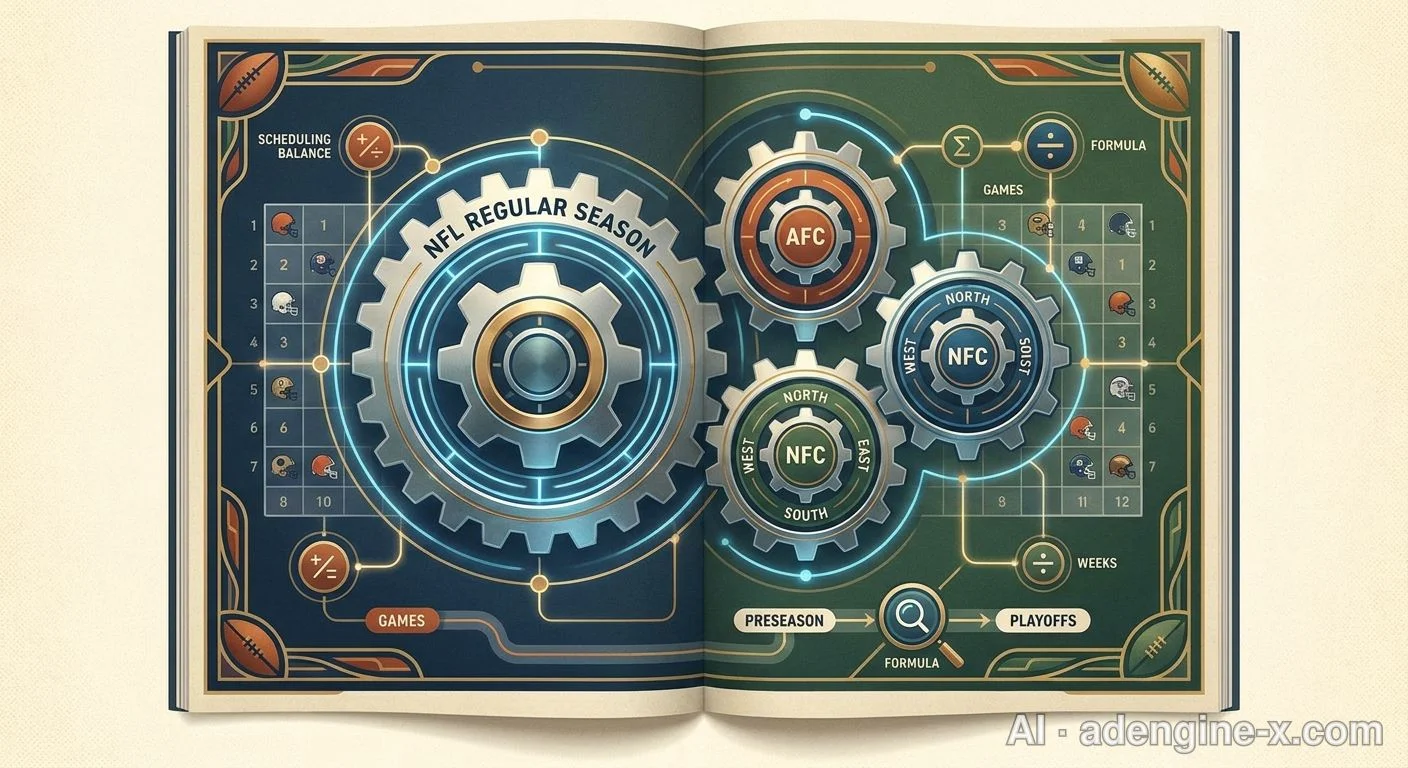
Category 1: Intra-Division Rivalries (6 Games)
Every team is placed in a four-team division within its conference (AFC East, North, South, West; NFC East, North, South, West). A club plays its three divisional opponents twice per season on a strict home-and-away basis. These six matchups represent the core bedrock of competitive qualification, directly informing division tiebreakers, conference head-to-head records, and playoff berths.
Category 2: Intra-Conference Division Rotation (4 Games)
Each division is paired against one of the other three divisions within the same conference on a recurring three-year rotational cycle. For instance, the AFC West plays all four teams in the AFC North in Year 1, the AFC South in Year 2, and the AFC East in Year 3. This guarantees that every franchise plays every intra-conference opponent at least once every three seasons, alternating two home games and two away games across the four matchups.
Category 3: Inter-Conference Division Rotation (4 Games)
Each NFL division matches up against an entire division from the opposing conference on a four-year rotational cycle. Over a four-year period, an AFC East team plays all four franchises in the NFC East, NFC North, NFC South, and NFC West once. The venue allocations balance equally: two home fixtures and two away fixtures. This rotation ensures that every player will theoretically play in every NFL stadium over an eight-year career span.
Category 4: Intra-Conference Parity Equalizers (2 Games)
To reinforce competitive parity under the "Any Given Sunday" doctrine, the league applies standing-based equalization games. A team plays the franchises that finished in the exact same divisional ranking (1st through 4th) from the remaining two intra-conference divisions that are not part of that year's three-year divisional rotation. For example, if a team finishes in 2nd place in the AFC North, and its division is scheduled to play the entire AFC South, it will be assigned single games against the 2nd-place finisher in the AFC East and the 2nd-place finisher in the AFC West. One game is assigned at home, the other away.
Category 5: The 17th Game Inter-Conference Formula (1 Game)
Introduced in 2021, the 17th game utilizes an inter-conference parity formula. A club matches up against a non-conference opponent that finished in the identical divisional standing the previous season, selected from an opposing division on an established four-year rotational matrix (excluding the full inter-conference division rotation scheduled that season). To eliminate structural bias regarding venue allocations, home-field advantage for this 17th matchup alternates across entire conferences each year: all 16 AFC franchises host the 9th home game in odd-numbered years, while all 16 NFC franchises host in even-numbered years.
4. Computational Optimization: The Engineering Behind Schedule Creation
Transforming 272 mathematically determined matchups into an operational 18-week master schedule represents a massive discrete optimization problem. The NFL Scheduling Department—directed by Vice President of Broadcast Planning Michael North and former Senior VP of Broadcasting Howard Katz—relies on high-performance cloud clusters to evaluate permutations that exceed the number of atoms in the observable universe.
Cloud Computing Clusters and Gurobi Solvers
The league reportedly deploys an optimization pipeline utilizing Amazon Web Services (AWS) running between 3,000 and 5,000 EC2 cloud instances concurrently. This computing grid runs mixed-integer linear programming (MILP) solvers powered by the Gurobi optimization suite. As Charlotte Carey, NFL Director of Broadcast Planning, noted regarding the computational evolution:
"In previous years, running a hundred computers overnight might yield zero valid schedules by morning. Today, AWS cloud parallel computing lets us filter tens of thousands of viable schedule options in days."

The search space evaluates approximately 576 potential kickoff windows against more than 26,000 hard and soft constraints. The objective function does not seek a singular "perfect" mathematical output, as no configuration can eliminate all stakeholder pain points. Michael North characterized this operational reality succinctly:
"We sit behind thousands of computers calculating options continuously. Scheduling is an art of compromise. Every owner, head coach, and network wants the ideal schedule, but no perfect schedule exists. When every stakeholder is equally dissatisfied, we've found the fairest possible schedule."
Variable Constraints and Hard Boundaries
The Gurobi optimization engine separates inputs into non-negotiable hard constraints (which must be satisfied for a schedule candidate to be valid) and prioritized soft constraints (which are balanced within the penalty objective function):
- Facility Sharing Collisions: The New York Giants and New York Jets share MetLife Stadium in East Rutherford, New Jersey; the Los Angeles Rams and Los Angeles Chargers share SoFi Stadium in Inglewood, California. The algorithm forbids simultaneous home games for paired tenants and requires minimum 24-hour maintenance buffers to swap artificial turf inlays, stadium LED graphics, and operational branding.
- Municipal Footprint and Parking Conflicts: In Kansas City, the Chiefs' GEHA Field at Arrowhead Stadium shares complex access and primary parking infrastructure with the MLB Kansas City Royals' Kauffman Stadium via the Truman Sports Complex. The engine incorporates blackout constraints to prevent concurrent high-volume events.
- Stadium Blackout Dates for Global Entertainment Tours: Modern NFL venues serve as multi-use economic hubs. Megastars such as Taylor Swift, Beyoncé, and Coldplay book stadium tours up to 12 to 18 months in advance. The algorithm inputs these concert dates as non-negotiable venue blackout restrictions.
- Competitive Fatigue Limits: The solver prevents teams from playing three consecutive road games whenever possible (a condition allowed only under extreme logistical crises). It also regulates short-week turnarounds, mandating that no team play consecutive Thursday games without intervening recovery windows.
Human Intuition and the Qualitative Layer
While algorithmic solvers generate approximately 100,000 fully compliant schedules, the selection of the finalized slate relies on qualitative assessment. Howard Katz, who spent decades engineering the schedule, framed this human-machine synthesis:
"Computer algorithms prove mathematical integrity, but they cannot comprehend the cultural energy of a December snowfall at Lambeau Field or the narrative weight of a fourth-quarter comeback. Our job is breathing human instinct and entertainment rhythm into the numbers."
5. Media Economics, Broadcast Windows, and Streaming Friction
The NFL schedule functions as the primary economic asset supporting an 11-year, $110 billion media rights portfolio spanning traditional broadcast networks and subscription streaming services.
Broadcast Window Architecture
To maximize total gross ratings points (GRPs), the schedule arranges games into standardized broadcast windows (Eastern Time standard):
- Thursday Night Football (8:15 PM ET): Streamed exclusively on Amazon Prime Video under an agreement valued at around $1 billion annually, anchoring Week 2 through Week 17.
- Sunday Regional Windows (1:00 PM ET & 4:05 PM ET): Distributed across CBS and FOX. CBS holds primary rights to AFC road games, while FOX holds primary rights to NFC road games, though cross-flexing protocols frequently alter these traditional alignments.
- Sunday National Doubleheader Window (4:25 PM ET): Rotated weekly between CBS and FOX. This single broadcast window routinely commands between 24 and 31 million viewers, representing the most-watched weekly television program in American media.
- Sunday Night Football (8:20 PM ET): Broadcast on NBC and streamed on Peacock. Valued at roughly $2 billion annually, SNF has ranked as primetime television's number-one rated show for over a decade.
- Monday Night Football (8:15 PM ET): Broadcast via ESPN and ABC under a $2.7 billion annual licensing contract held by The Walt Disney Company.
- International Series Window (9:30 AM ET): Games contested in London (Wembley Stadium, Tottenham Hotspur Stadium), Germany (Allianz Arena, Deutsche Bank Park), and South America (Neo Química Arena in São Paulo) broadcast on NFL Network or assigned to bespoke streaming licensees.
Direct-to-Consumer Fragmentation and Fan Financial Burden
The modern distribution matrix has altered the financial cost of access for fans. Prior to 2020, an over-the-air (OTA) HD digital antenna and basic regional cable service provided coverage of virtually all regular-season contests. In contrast, comprehensive access now requires navigating a fragmented direct-to-consumer (DTC) ecosystem:

- Amazon Prime Video: ~$139/year (TNF exclusivity + Black Friday game).
- Peacock Premium: ~$59.99–$79.99/year (Exclusive regular season/wildcard game windows).
- Netflix: ~$83.88/year minimum (Securing multi-year Christmas Day doubleheaders at an estimated $75 million per-game license).
- YouTube TV + NFL Sunday Ticket: ~$349–$449/season (Excluding base YouTube TV carriage fees of $72.99/month for out-of-market regional Sunday games).
This digital distribution landscape routinely pushes the all-in baseline expenditure for complete regular-season access past $700–$800 annually. This operational shift continues to generate notable consumer friction on community channels, even as it generates record broadcast revenues for the league.
6. Competitive Disparities: Rest Inequity and Travel Logistics
Despite the league's mathematical parity formulas, an asymmetric schedule introduces substantial physical and competitive performance discrepancies across franchises.
Quantifying the Rest Differential
The NFL schedule features built-in recovery imbalances. A normal weekly game cadence provides six intervening rest days (Sunday to Sunday). However, high-frequency short-week transitions and asynchronous bye-week timing create stark rest differentials:
- The Thursday Turnaround: A team contesting a road matchup on Sunday afternoon followed by a road contest on Thursday Night Football experiences approximately 72 hours of recovery and preparation time, leading to elevated physical strain and condensed tactical installation.
- The Post-Bye Disparity: Teams matched against an opponent coming off its designated bye week face a club benefiting from 14 days of physical recuperation and game planning. Empirical analytical modeling confirms that an aggregate negative net rest differential across a regular season correlates with a measurable decline in expected winning percentage, particularly when paired with multi-time-zone travel.
Geographic Flight Mileage and Circadian Variance

The physical geography of the United States produces significant travel disparities between coastal franchises and interior teams. West Coast teams such as the Seattle Seahawks, San Francisco 49ers, and Los Angeles Chargers routinely log between 25,000 and 32,000 flight miles per season—equivalent to more than one complete circumnavigation of the globe. Conversely, centrally located or East Coast clubs situated near dense rail and flight corridors (such as the Pittsburgh Steelers, Carolina Panthers, or Washington Commanders) often travel fewer than 8,000 to 13,000 miles in a single campaign. Crossing multiple time zones frequently forces West Coast franchises to play in the 1:00 PM ET (10:00 AM Pacific body clock time) window, a biological challenge that teams address through tailored sleep science and circadian acclimatization protocols.
7. Step-by-Step Practical Implementation Guide: A 3-Night, 4-Day NFL Travel Playbook
Attending an NFL game requires navigating secondary ticket dynamics, venue security, and transportation flows. The following technical protocol outlines a complete 3-Night, 4-Day operational itinerary designed to maximize game-day efficiency and reduce travel disruption.
Phase 1: Pre-Trip Planning and Strategic Ticket Acquisition
Execute primary and secondary market acquisitions according to standard price distribution curves:
- Initial Release Window (Mid-May): Primary single-game tickets launch across platforms such as Ticketmaster and SeatGeek within hours of the official schedule announcement. High-profile divisional matchups (e.g., Kansas City Chiefs at Buffalo Bills; Dallas Cowboys at Philadelphia Eagles) establish secondary market markups of 200% to 300% on day one. Secure lower-bowl seats immediately if zero variance in seating location is required.
- Price Decay Assessment (T-Minus 14 to 3 Days): For colder-climate open-air stadiums in December (such as Lambeau Field, Highmark Stadium, or Cleveland Browns Stadium) or when tracking teams with declining playoff odds, aggregate ticket prices routinely drop 30% to 50% in the final 72 hours before kickoff. Monitor secondary exchange inventory levels strategically.
Phase 2: Master 3-Night, 4-Day Field Execution Itinerary
The following deployment plan applies to standard Sunday afternoon kickoff slates:
Friday (Day 1: Ingress and Tactical Staging)
- 12:00 PM – 3:00 PM: Arrive at the host metro airport. Secure ground transit or reserve rental vehicles that include stadium parking credentials. Avoid booking accommodations directly adjacent to highway stadium zones; instead, secure lodging in central transit corridors with direct heavy-rail links to avoid game-day congestion.
- 4:00 PM – 6:00 PM: Hotel check-in and local credential inspection. Verify that stadium digital tickets are transferred to your native smartphone digital wallet (Apple Wallet or Google Wallet) to bypass venue cellular-network dead zones.
- 7:30 PM: Evening team-district reconnaissance and stadium perimeter walkthrough to evaluate pedestrian choke points and designated ride-share lots.
Saturday (Day 2: Fan Engagement and Facility Tours)

- 10:00 AM – 1:00 PM: Execute pre-booked stadium facility tours. Most venues offer official stadium architecture, locker room, and field-access walk-throughs on the day preceding a home game (reservations required 60 days in advance).
- 2:00 PM – 5:00 PM: Regional team history and museum engagement (e.g., the Pro Football Hall of Fame in Canton, Green Bay Packers Hall of Fame, or franchise historical centers).
- 6:30 PM: Final review of the NFL Inactive List and injury reserve statuses (typically submitted 90 minutes prior to kick, with final health updates verified Saturday evening). Reconfirm weather forecasts, packing cold-weather thermals or certified wet-weather gear accordingly.
Sunday (Day 3: Game Day Field Operations)
- 8:00 AM – 9:00 AM: Morning operational gear check. Ensure compliance with the NFL Clear Bag Policy (bags must be clear plastic, vinyl, or PVC and not exceed 12" x 6" x 12", or small clutch bags not exceeding 4.5" x 6.5"). Verify that personal battery charging packs comply with specific stadium limits.
- 9:30 AM: Arrive at the stadium grounds. Tailgating parking passes typically open 4.5 hours prior to kickoff. Experience the team tailgating footprint or proceed to pre-booked corporate hospitality spaces.
- 11:30 AM (T-Minus 90 Minutes): Proceed through magnetic perimeter security scanners to clear security before entry volume peaks. Monitor official 90-minute pre-game inactive rosters.
- 1:00 PM – 4:15 PM: Live contest window. Factor in television commercial timeouts, official reviews, and extended 12-minute halftime transitions.
- 4:30 PM – 6:30 PM: Post-game stadium egress. Heavy traffic around the stadium perimeter routinely delays ride-share pickup zones by 60 to 90 minutes. Defer vehicle egress by waiting within stadium club concourses or walking to surrounding commercial zones.
Monday (Day 4: Post-Operations and Egress Departure)
- 9:00 AM – 11:00 AM: Review final official NFL game statistics, Snap Count allocations, and Pro Football Focus (PFF) grade sheets. Complete hotel checkout.
- 12:00 PM onward: Terminal arrival and return transit. Maintain an operational travel buffer of at least 3 hours at airport terminals following high-traffic NFL host-city weekends.
8. Critical Vulnerabilities, Pitfalls, and Flexible Scheduling Traps
Attending or scheduling media consumption around the NFL regular season requires understanding the administrative guardrails that protect competitive balance, which can disrupt fan travel plans if overlooked.
The Flexible Scheduling Hazard
The league reserves unilateral authority to alter game kickoffs, days, and distribution networks to optimize viewership ratings. Planning trips without factoring in these scheduling policies can lead to missed flights or surprise overnight extensions:
- Sunday Night Football Flex: May be applied up to twice between Weeks 5 and 10, and flexibly applied without hard caps between Weeks 11 and 17. The league must provide a minimum 12-day notification window (e.g., altering a 1:00 PM ET kickoff to an 8:20 PM ET primetime slot).
- Monday Night Football Flex: Active from Weeks 12 to 17, operating under a minimum 12-day notification threshold. A Sunday afternoon game can be pushed to Monday evening, rendering Sunday-night return flights unusable.
- Thursday Night Football Flex: Permitted up to twice per season between Weeks 13 and 17. Because shifting an itinerary to Thursday represents a significant logistical adjustment, the league mandates a minimum 28-day notice to ticket holders.
- Week 18 Scheduling Strategy: The final week of the season features zero pre-assigned kickoff times on the master schedule. The league waits until the completion of Week 17 Sunday Night Football to finalize the Week 18 slate, assigning games to Saturday afternoon, Sunday afternoon, or Sunday night slots to ensure competitive integrity among teams competing for playoff seeds.
Logistical and Ticket Authentication Countermeasures
- Paper PDF Ticket Counterfeiting: Static paper printouts or PDF screenshots are no longer accepted at any NFL venue. Modern venues utilize rotating barcoded NFC mobile ticketing. Purchasing from untrusted street brokers outside stadium gates carries a near-total risk of purchasing invalid or already scanned credentials.
- Clear Bag Enforcement Discard Traps: Non-compliant purses, backpacks, and professional camera cases will be rejected at outer perimeter screening points. Venues typically offer external locker check services for fees between $10 and $25, but capacity is limited and retrieving bags postgame can cause significant egress delays.
9. Strategic Outlook: An 18-Game Regular Season and the Global Era
The architecture of the NFL schedule is approaching its next major transformation as the league pursues long-term expansion goals ahead of the expiration of the current CBA in 2030.
The 18-Game / 2-Preseason Configuration
League leadership, spearheaded by NFL Commissioner Roger Goodell, continues to explore the transition from the current 17-game format to an 18-game regular season paired with a 2-game preseason calendar. Strategic considerations for this shift include:
- The Double Bye Week Model: To balance the physical toll of 18 regular season games, the league and the NFLPA are evaluating the introduction of a second designated bye week for each club across a 20-week calendar.
- Super Bowl Relocation to Presidents' Day Weekend: Adding a 20th calendar week would shift the Super Bowl from the second Sunday in February to the third Sunday, placing it the day before the Presidents' Day federal holiday. This positioning creates a three-day weekend for millions of American workers and consumers, unlocking higher hospitality yields and stronger broadcast viewership numbers.
Expansion of the International Series
Commissioner Roger Goodell has reiterated the league's global ambitions during seasonal press briefings:
"Our long-term vision focuses on expanding the NFL platform worldwide. Moving across London, Munich, Frankfurt, São Paulo, and Madrid is just the beginning. Transitioning our regular-season structure and broadening international fixtures is the natural next step to deliver the game to international audiences."
The league continues to expand its global footprint, adding destinations such as Madrid's Santiago Bernabéu Stadium to established stops in London, Germany, and São Paulo. The operational goal remains for all 32 clubs to play internationally every few seasons, setting up a recurring 9:30 AM ET "Global Sunday" broadcast window designed to generate high engagement in European, South American, and morning North American markets.

10. Frequently Asked Questions (FAQ)
Q1: Why does my team play another team from a different division for three consecutive years?
A: This occurs because the NFL formula utilizes standing-based parity matching alongside rotational division pairings. If Team A and Team B consistently finish in the exact same position within their respective conference divisions (for example, both finishing in second place), the intra-conference parity formula assigns them to play head-to-head, even in years when their entire divisions are not paired in the three-year conference rotation.
Q2: How does the NFL decide which conference receives nine regular-season home games?
A: Under the 17-game format adopted in 2021, home-field advantage for the odd 17th game alternates across entire conferences each season. In odd-numbered years, all 16 AFC franchises host nine regular-season home games and one preseason home game. In even-numbered years, all 16 NFC franchises host nine regular-season home games and one preseason home game.
Q3: How far in advance can the NFL flex a Sunday afternoon game to Sunday Night Football?
A: For matchups scheduled between Weeks 5 and 13, the league must provide at least 12 days of advance notice before moving a game to NBC's Sunday Night Football. For the Week 14 to 17 stretch, the minimum notification window remains 12 days, while the critical Week 18 regular-season finale is set with approximately 6 days of advance notice (announced late Sunday evening at the conclusion of Week 17).
Q4: Why are some Sunday afternoon games featuring AFC teams broadcast on FOX, and NFC games on CBS?
A: This arrangement is the result of the league's "cross-flexing" protocol. While CBS remains the historical primary rightsholder for the AFC package and FOX retains the NFC package, the NFL's broadcasting department exercises cross-flex rights to balance weekly programming slates, resolve regional audience distribution overlaps, and ensure both networks feature compelling late-afternoon doubleheaders.
Q5: What is the most cost-effective method for watching out-of-market NFL games legally?
A: For fans living outside their favorite franchise's regional television market, YouTube TV's NFL Sunday Ticket is the designated primary platform. To optimize annual streaming costs, monitor pre-season bundle promotional discounts (frequently discounted by $50 to $100 for current platform subscribers), explore verified university student verification plans, or assess whether localized mobile viewing packages (such as NFL+) provide adequate coverage for your media setup.
ℹ️ This article was drafted with the help of an AI tool and reviewed/edited by a human before publishing. · Original: AdEngine-X
📚 References
This list may include both live search sources the AI referenced while writing and public-data sources checked during fact verification. Please verify the original sources before citing or reusing.
0 Comments
Loading comments...