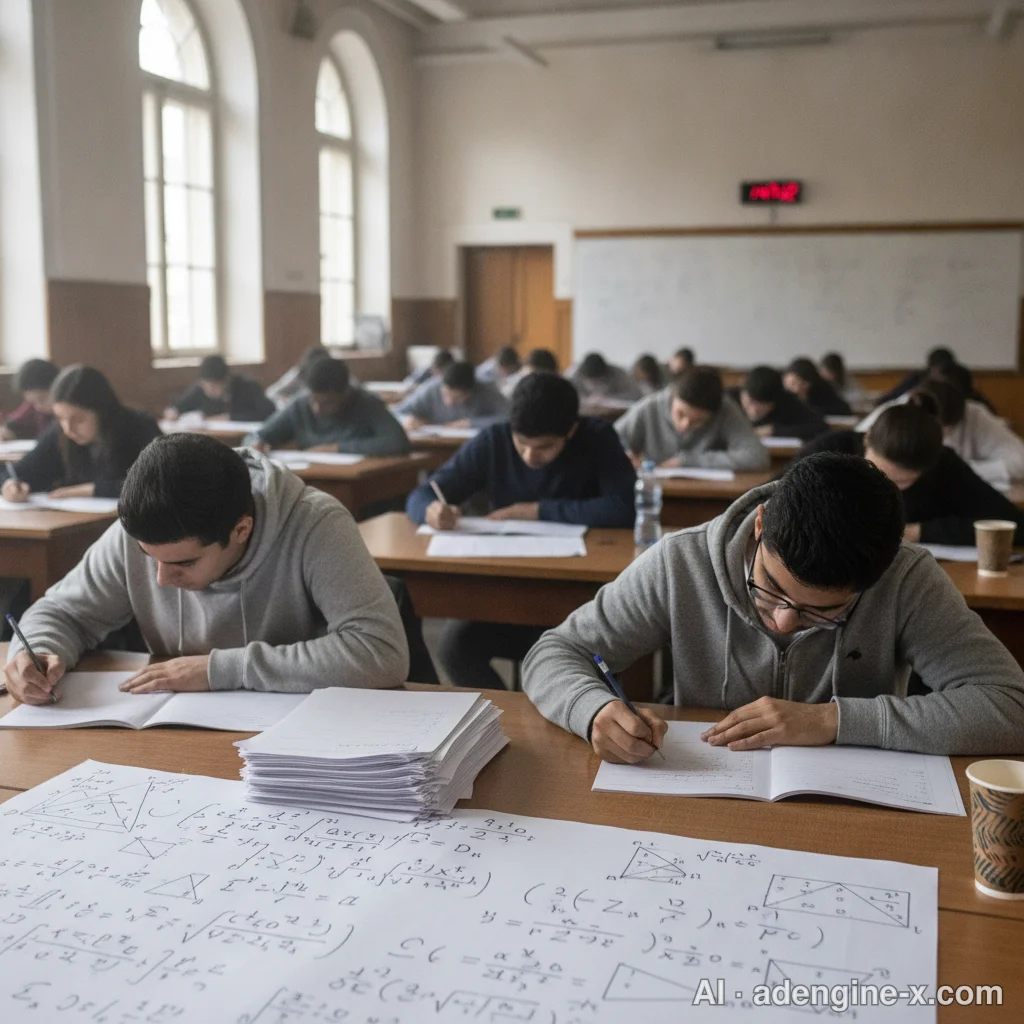
OpenAI Mathematics Mistakes Users Make When Prompting o-Series
(Advertisers wanted)
(Advertisers wanted)
📌 Topic & Subject
This article explores how OpenAI's o-series reasoning models handle complex mathematical benchmarks like AIME and the IMO through test-time compute. It discusses the transition from traditional language models to natural language reasoning systems and highlights the importance of proper prompting strategies and human verification to avoid subtle mathematical errors.
(Advertisers wanted)
(Advertisers wanted)
📌 Table of Contents
- 1. Benchmark evidence across models
- 2. The mechanics behind the answers
- 3. Where the proofs fall apart
- 4. Practical setup for rigorous answers
OpenAI reasoning models hit a record 96.7% on the 2024 American Invitational Mathematics Examination, but you can easily ruin that output by prompting them like ordinary chat models. A single missing instruction or an unchecked raw proof will waste expensive tokens and introduce quiet mathematical errors.
Key takeaways:
- An experimental OpenAI reasoning model reportedly scored 35 out of 42 on the 2025 IMO benchmark.
- Without high reasoning effort enabled, complex proofs often fail on edge cases.
- Hidden chain-of-thought tokens cost up to $80 per million output tokens.
Benchmark evidence across models
Just a few years ago, large language models regularly stumbled over basic three-digit multiplication. When OpenAI published the Grade School Math 8K benchmark in 2021 with 8,500 elementary arithmetic problems, critics called transformer models stochastic parrots that could never handle real proofs. That skepticism crumbled after Karl Cobbe and Hunter Lightman published Let’s Verify Step by Step in 2023.
That work replaced traditional outcome-supervised reward models with process-supervised reward models. Instead of judging only the final answer, the system reportedly verified every intermediate step. The research reportedly fed the internal project known as Q* and later Project Strawberry. By late 2024, OpenAI reportedly turned that research into the o1 and o3 model series.
| Evaluation Metric | GPT-4o Baseline | OpenAI o1 | OpenAI o3 |
|---|---|---|---|
| AIME 2024 Single Run | 13.4% (1.8/15) | 74.0% (11.1/15) | 96.7% |
| AIME 2024 (Reranked / Consensus) | N/A | 93.0% (1,000 samples) | Human ceiling |
| FrontierMath Benchmark | < 2.0% | Internal preview | 25.2% |
| IMO 2025 Test Protocol | Unranked | Partial proofs | 35/42 (Experimental model) |
| API Input / Output per 1M Tokens | $2.50 / $10.00 | $15.00 / $60.00 | $20.00 / $80.00 (o3-pro) |
On the 2025 International Mathematical Olympiad test, an OpenAI team led by Alexander Wei ran an experimental model under human conditions. The run had no internet access, used no code interpreter, and lasted nine hours across two days. The system solved five out of six problems, scoring 35 out of 42 points.
The FrontierMath dataset presents an even harder challenge. Built by Epoch AI alongside sixty research mathematicians, it contains three hundred research-level problems. While older flagships scored under 2%, o3 reached 25.2% with extended compute.
The mechanics behind the answers
The core breakthrough reportedly comes from test-time compute. Instead of generating an instant token stream, the model explores internal chains of thought before writing a word. It backtracks when an algebraic transformation leads to an impossible state.
Noam Brown noted that test-time compute allows an artificial intelligence model to search and verify moves like a chess engine. The model reportedly critiques its own scratchpad. It uses the PRM800K dataset, which holds 800,000 human step-level annotations, to assess whether an argument holds.

This approach contrasts sharply with Google DeepMind. DeepMind built AlphaGeometry and AlphaProof around the Lean formal programming language. Formal approaches eliminate hallucinations completely, but translating natural language into Lean takes significant human labor. OpenAI chose pure natural language reasoning instead, trading compiler safety for broad flexibility across topics.
Where the proofs fall apart
You run into severe problems if you treat these outputs as verified theorems. The natural language engine can sound completely confident while slipping past a subtle division by zero or a flawed boundary condition. Pure synthetic reasoning still lacks an internal compiler.
Terence Tao tested o1-preview on advanced complex analysis and algebraic geometry. He described working with the model as similar to advising a "mediocre, but not completely incompetent" graduate student. It speeds up tedious algebraic reorganizations, but it does not direct the overarching strategy.
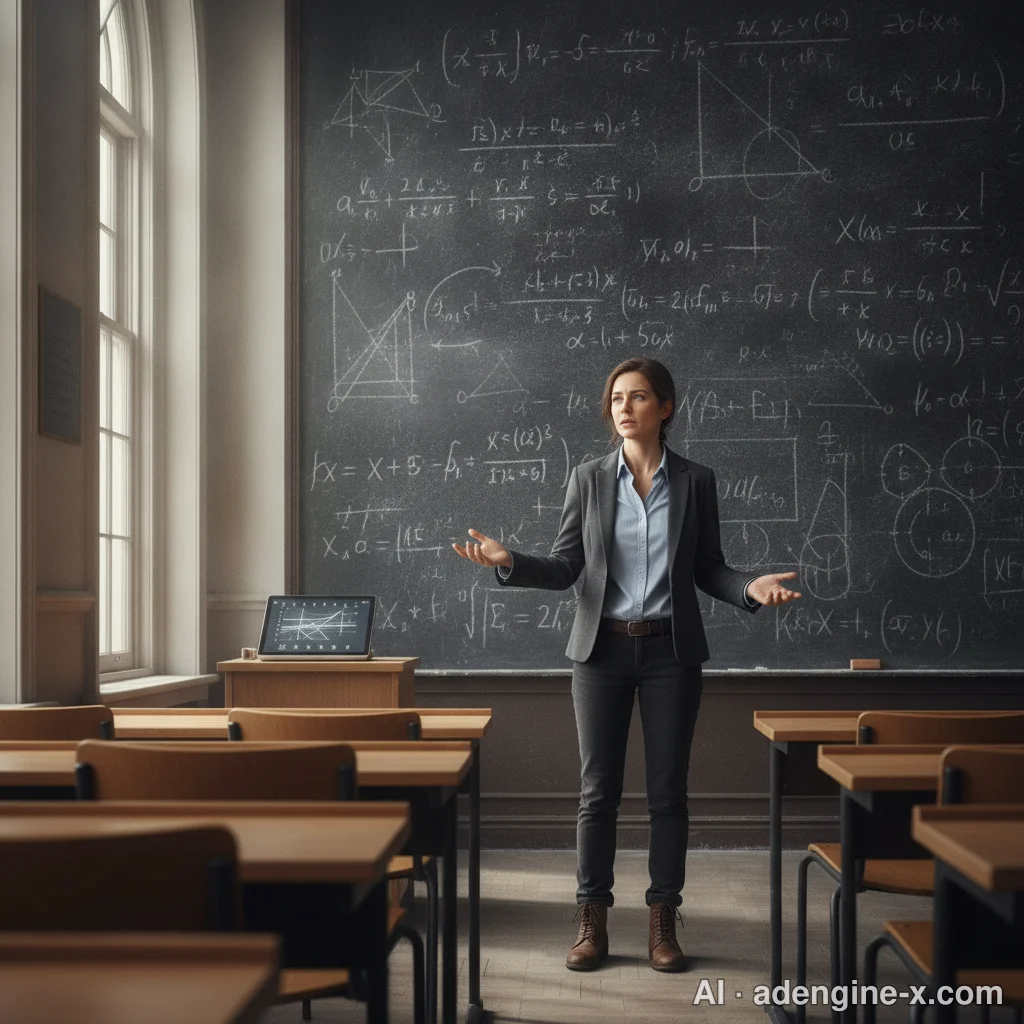
Benchmark integrity reportedly remains a sore spot. Controversy emerged around FrontierMath when reports confirmed that OpenAI provided backing funding and gained early access to problems before release. Pure Euclidean geometry reportedly remains another weak spot, where visual space descriptions sometimes distort without an explicit coordinate system.
Practical setup for rigorous answers
If you want dependable math answers, you need to adjust your setup. Free ChatGPT tiers reportedly offer strictly limited access to o3-mini. The $20 monthly ChatGPT Plus subscription reportedly provides o1 and o3-mini, while the $200 monthly Pro tier reportedly gives extended access to o1-pro and o3-pro.
Developers using the API are advised to set the reasoning parameter deliberately. Add reasoning_effort: high into your payload when evaluating difficult problems. If you leave it on low, the system skips deeper verification loops to save compute time.
Never send a simple prompt like “solve this equation.” Instead, instruct the model: “Do not jump to conclusions. First, write down the edge cases, test them using Python sympy code, verify each step rigorously, and refute your own hypotheses before writing the final proof.” Expect waiting times between 30 and 120 seconds while the model completes its hidden reasoning steps.
Bottom line: use o-series models to draft complex derivations, but verify every boundary condition yourself before relying on the math.
ℹ️ This article was drafted with the help of an AI tool and reviewed/edited by a human before publishing. · Original: AdEngine-X
More from this author



📚 References
This list may include both live search sources the AI referenced while writing and public-data sources checked during fact verification. Please verify the original sources before citing or reusing.
0 Comments
Loading comments...