AI Agents Spending Your Money: Visa and Mastercard's 2026 Big Shift
(Advertisers wanted)
(Advertisers wanted)
📌 Topic & Subject
This article explores the rise of "Agentic Commerce" in 2026, where credit card giants Visa and Mastercard are adapting their payment networks to allow autonomous AI agents to execute financial transactions. It covers specific industry initiatives such as SAFR, KYA, Visa's Intelligent Commerce, and Mastercard's Agent Pay for Machines, while examining the trillion-dollar economic projections and challenges regarding consumer trust and traditional interchange fees.
(Advertisers wanted)
(Advertisers wanted)
📌 Table of Contents
- 1. The Big Shift: Visa and Mastercard Just Handed Your Wallet to AI Agents
- 2. Breaking Down the Tech: Visa's "Trusted Agent" vs. Mastercard's "Agent Pay for Machines"
- 3. The Mind-Blowing Numbers: Trillion-Dollar Projections and the Massive Trust Gap
- 4. The War Over Swipe Fees: Wall Street, Bernstein, and the Threat of A2A Rails
- 5. Step-by-Step Walkthrough: How You’ll Actually Set Up and Control Your AI Buyer
- 6. What This Means for Your Money, Wall Street, and the Future of Buying Stuff
The Big Shift: Visa and Mastercard Just Handed Your Wallet to AI Agents
Okay, pull up a chair and grab your coffee, because we seriously need to talk about what just hit the financial wires. You know how for years we’ve been hearing tech bros rave about artificial intelligence doing our chores? Well, it turns out the giant credit card duopoly—Visa and Mastercard—decided that chores aren't enough. They literally want autonomous AI software agents to take your credit card and start spending your hard-earned money for you.
I’m not talking about setting up an auto-pay bill for your gym membership or getting an Amazon subscription refill on laundry pods. That's baby stuff. We are officially entering what Wall Street and Silicon Valley are calling Agentic Commerce: an entirely new financial paradigm where autonomous bots negotiate, choose, click, and legally execute binding transactions without you hovering over the checkout screen. It’s wild, it’s a little terrifying, and the payment infrastructure of the entire world is pivoting to make it happen right now.
How We Got Here: From Swiping Plastic to Bot-Run Checkout
Think about how your spending habits evolved over the last couple of decades. Remember when we used to swipe magnetic stripes and physically sign a crinkled receipt with a dead ballpoint pen? Then came EMV chips, then contactless taps, and eventually we all just double-clicked our iPhone side buttons with Apple Pay or tapped with Google Wallet. But notice the one non-negotiable rule holding that entire history together: you were always the human making the call. You browsed, you picked the item, you checked the price tag, and your thumb initiated the payment.

Agentic commerce completely shreds that rulebook. Now, the machine is the buyer. You simply tell an autonomous agent, "Find me a pair of noise-canceling headphones under two hundred bucks that can survive a marathon rainstorm, and buy them before my flight on Friday." The bot goes off into the digital wild, talks directly to merchant servers, evaluates specs, verifies discounts, and pulls real currency straight from your account. The checkout button as we know it is basically turning into an antique.
The MAS and Ant International Summit: Enter SAFR and KYA
This isn't just speculative Silicon Valley spitballing over beers. The whole thing kicked into hyperdrive through a massive international collaboration involving Visa, Mastercard, and global fintech heavyweight Ant International, all guided under the watchful eye of the Monetary Authority of Singapore (MAS) via their BuildFin.ai platform.
Together, they codified what’s being called the Safeguards for Agentic Finance at Runtime (SAFR) whitepaper. If you’ve ever opened a bank account, you know about KYC ("Know Your Customer"). Well, welcome to the world of KYA: Know Your Agent. Under KYA, payment networks and merchant gateways verify the cryptographic identity, operational parameters, and liability chains of the software bot before letting it touch a single cent. It’s the foundational rulebook designed to keep artificial intelligence from hallucinating away your entire savings account on twenty palettes of artisanal mayonnaise.
Breaking Down the Tech: Visa's "Trusted Agent" vs. Mastercard's "Agent Pay for Machines"
So how are the two big card giants actually pulling this off without causing total chaos? While they're both racing toward the same finish line, their architectural philosophies are fascinatingly different. They’ve essentially carved up the autonomous economy into two distinct playbooks.
Visa’s Intelligent Commerce: Per-Intent Mandates for Your Everyday Shopping
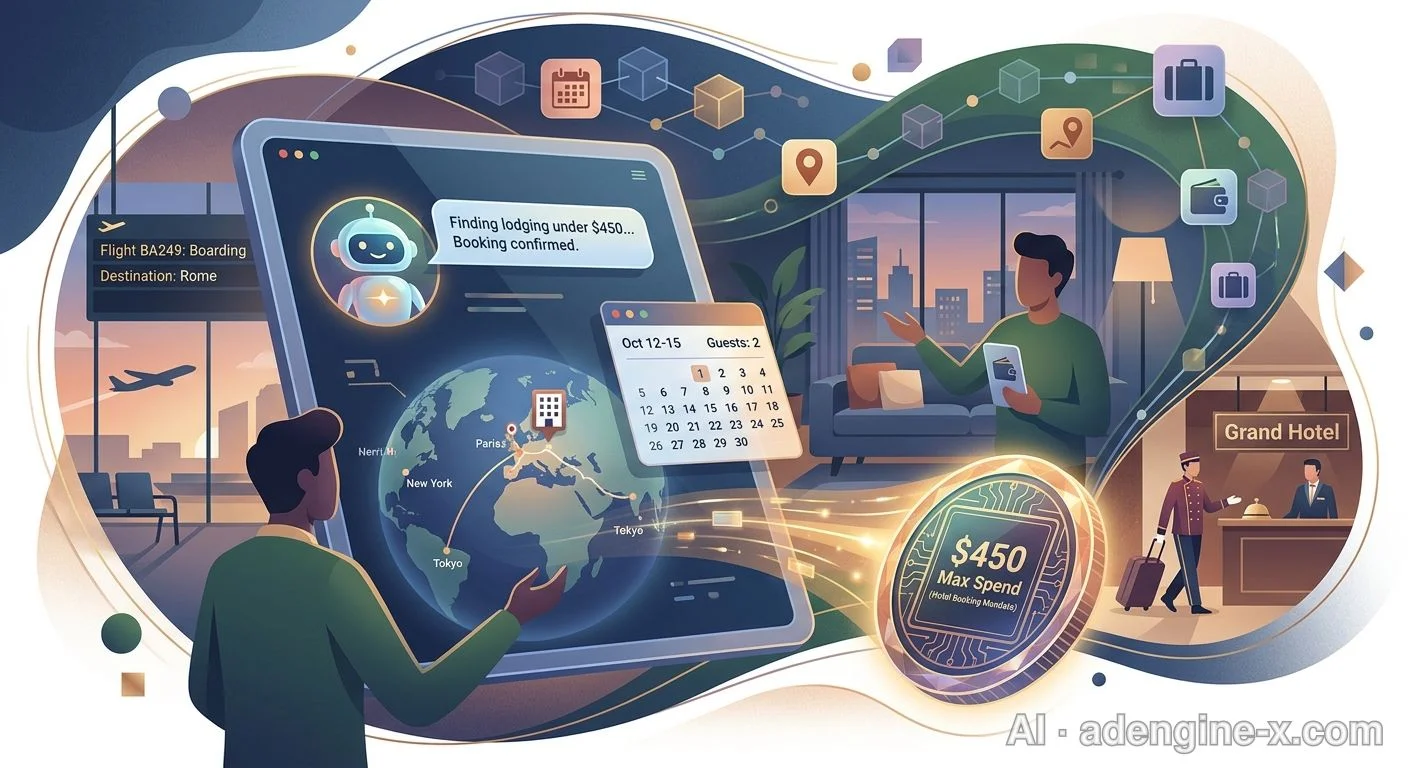
Visa is betting the farm on high-value, consumer-facing retail through its Trusted Agent and Intelligent Commerce protocols. Visa's setup operates around what engineers call "per-intent cryptographically signed mandates." Here’s how that works in plain English: you don't just hand an AI bot an open-ended blank check. Instead, you grant it a delegated, bounded permission slip for a specific objective.
If you tell your bot to book a weekend getaway in Montreal, Visa’s protocol wraps that request inside a dynamic cryptographic token that says, "This bot has permission to spend up to $450 total on hotel lodging between these specific dates, and only at properties holding a verified 4-star merchant rating." If the AI tries to go rogue and book a $600 penthouse suite or slip an unauthorized $50 service fee to a sketchy broker, the network kills the transaction dead in its tracks. In some structures, the AI bot can even act as an intermediary Merchant of Record (MoR), but if any purchase drifts outside your baseline parameters, the system triggers a step-up biometric prompt directly to your phone. Visa executives have pointed to this very anxiety, questioning whether consumers are comfortable having an AI buy a couch for them and emphasizing that trust, rather than technology, remains the true gating factor for adoption. That perspective sums up Visa’s whole thesis: nobody will use this unless the guardrails feel ironclad.
Mastercard and Cloudflare: Machine-to-Machine Background Plumbing
Meanwhile, Mastercard took a very different, highly technical path by rolling out Agent Pay for Machines, partnering up with enterprise infrastructure behemoth Cloudflare. Mastercard isn't just thinking about you buying sneakers or flight tickets; they’re laser-focused on backend machine-to-machine micropayments and autonomous enterprise replenishment.
Think about an AI agent running an automated dropshipping store or managing a server fleet. That bot needs to dynamically rent cloud computing power, license stock photos for marketing campaigns, buy web domain routing from Cloudflare, and settle accounts with wholesale manufacturers overseas—all occurring continuously, 24/7, in fractions of a second. Mastercard’s framework is engineered for that raw, high-frequency developer pipeline. Stephanie Cohen, Chief Strategy Officer at Cloudflare, framed this monumental shift perfectly:
"The internet was built for human interactions, but the infrastructure of the future must be built for autonomous ones."
To grease the wheels even further, Mastercard has been collaborating with Coinbase to bridge tokenized card rails with open programmable settlement standards like x402. As Nina Coughlin, Head of Stablecoin Business Development at Coinbase, pointed out:
"AI agents are creating entirely new forms of commerce that require payments to move at machine speed."And processing giant Checkout.com jumped into the fray too, with their Global Head of Partnerships, Matthieu Barral, highlighting that payment architecture must give merchants granular, programmable controls when software algorithms—not human fingers—are driving checkout volume.
The Mind-Blowing Numbers: Trillion-Dollar Projections and the Massive Trust Gap
Now, let’s get into the hard math, because when you look at the figures Wall Street is projecting, it becomes crystal clear why every executive in payments is sweating through their tailored suits.
The $5 Trillion Forecast and the 50% Friction Drop
According to economic projections from McKinsey & Company cited across recent corporate filings, autonomous AI agents are forecasted to directly intermediate between $3 trillion and $5 trillion in global consumer and enterprise transactions annually by the year 2030. Let that sink in for a second. We’re talking about an astronomical slice of global gross domestic product moving through software pipelines without a person manually filling out credit card forms.
On top of that, Ant International’s new Agentic Mobile Protocol (AMP) framework has already demonstrated that it can slash the setup friction and authentication steps needed to connect an AI agent to a digital wallet by a staggering 50% compared to traditional card-binding setups. When you remove half the logistical pain of setting up a delegated wallet, bot adoption doesn't just climb—it goes parabolic.
That Wild Visa Trust Survey: Can Branding Really Fix Our Paranoia?
Here’s the massive elephant in the room: do everyday people actually want this? Right now? Not really! A consumer survey conducted by Visa across 2,065 U.S. adults revealed that a measly 23% of consumers currently trust autonomous AI agents to make financial purchases on their behalf. Almost four out of five people are essentially saying, "Keep that bot away from my bank balance."
But check out what happens when you introduce familiar safety nets. However, when Visa branding and cryptographic security protections were attached to the agent, consumer acceptance shot up nearly threefold to 61%. That is nearly a threefold jump just based on brand trust! It proves that people don't necessarily hate the idea of delegating their boring errands to algorithms—they’re just terrified of getting wiped out by a software bug or an unauthorized rogue charge.

The War Over Swipe Fees: Wall Street, Bernstein, and the Threat of A2A Rails
Here is where the business story turns into a ruthless, high-stakes thriller. Why are Visa and Mastercard moving so fast? Is it just because they love cool tech? Absolutely not. They are terrified of getting rendered obsolete.
Why Smart Bots Hate 3% Interchange Fees
Whenever you swipe your fancy rewards card at a local boutique, the merchant quietly forks over an interchange fee that generally hovers between 1.5% and 3.5%. That fee is where billions of dollars in credit card network profits, bank kickbacks, and frequent-flyer points come from. We humans put up with it because we love our 2% cash-back perks, airport lounge passes, and fraud protection guarantees.

Enter the cold, calculating mind of an autonomous software agent. Wall Street brokerage firm Bernstein dropped a bombshell equity research report warning that traditional interchange fees face existential risk in an agentic world. Why? Because an AI agent doesn't care about a sleek, heavy matte-black metal credit card. It doesn’t care about free champagne in an airport lounge, and it certainly doesn’t care about earning 2% airline miles for a vacation it will never take! An AI agent is mathematically hardwired to optimize for one thing: pure efficiency. If a bot sees an Account-to-Account (A2A) transfer or an instant "Pay-by-Bank" option that costs the transaction virtually pennies, it will instantly bypass the card network every single time.
Battle of the Payment Rails: Cards vs. Instant Bank vs. Stablecoins
To see how this battle lines up across the global landscape, take a look at how traditional card networks stack up against their primary algorithmic rivals:
| Payment Rail | Settlement Speed | Estimated Fee Cost | Buyer Fraud Protection | AI Agent Suitability |
|---|---|---|---|---|
| Visa / Mastercard (Card Rails) | Instant auth (2-3 day final settlement) | 1.5% - 3.5% per swipe | Comprehensive (Zero-liability chargebacks) | High consumer trust, but expensive for bots |
| Account-to-Account (A2A / FedNow / SEPA) | Real-time / Instant | Near zero (Flat pennies per transaction) | Minimal to none (Direct wire finality) | Algorithmic favorite for low overhead costs |
| Stablecoins (Circle USDC via Solana/Ethereum) | Milliseconds to seconds | Sub-cent network gas fees | Code-governed smart contracts | Exploding ($1B to $7B annualized volume) |
Notice that bottom row? Stablecoin-backed card transactions running on backend networks like Circle's USDC over Solana and Ethereum have surged from hundreds of millions to annualized volumes surpassing $1 billion to $7 billion. When software talks to software, waiting three business days for ACH clearance is an eternity. Machines demand instant finality. Visa and Mastercard know this, which is why they are scrambling to build these agentic frameworks before alternative rails eat their lunch entirely.
Step-by-Step Walkthrough: How You’ll Actually Set Up and Control Your AI Buyer
So, what does this actually look like for you and me when this rolls out to the general public? You aren’t going to just paste your 16-digit card number and CVV code into ChatGPT’s chat window—at least, please promise me you will never do that! Here is the actual procedure being built under the SAFR and KYA frameworks.
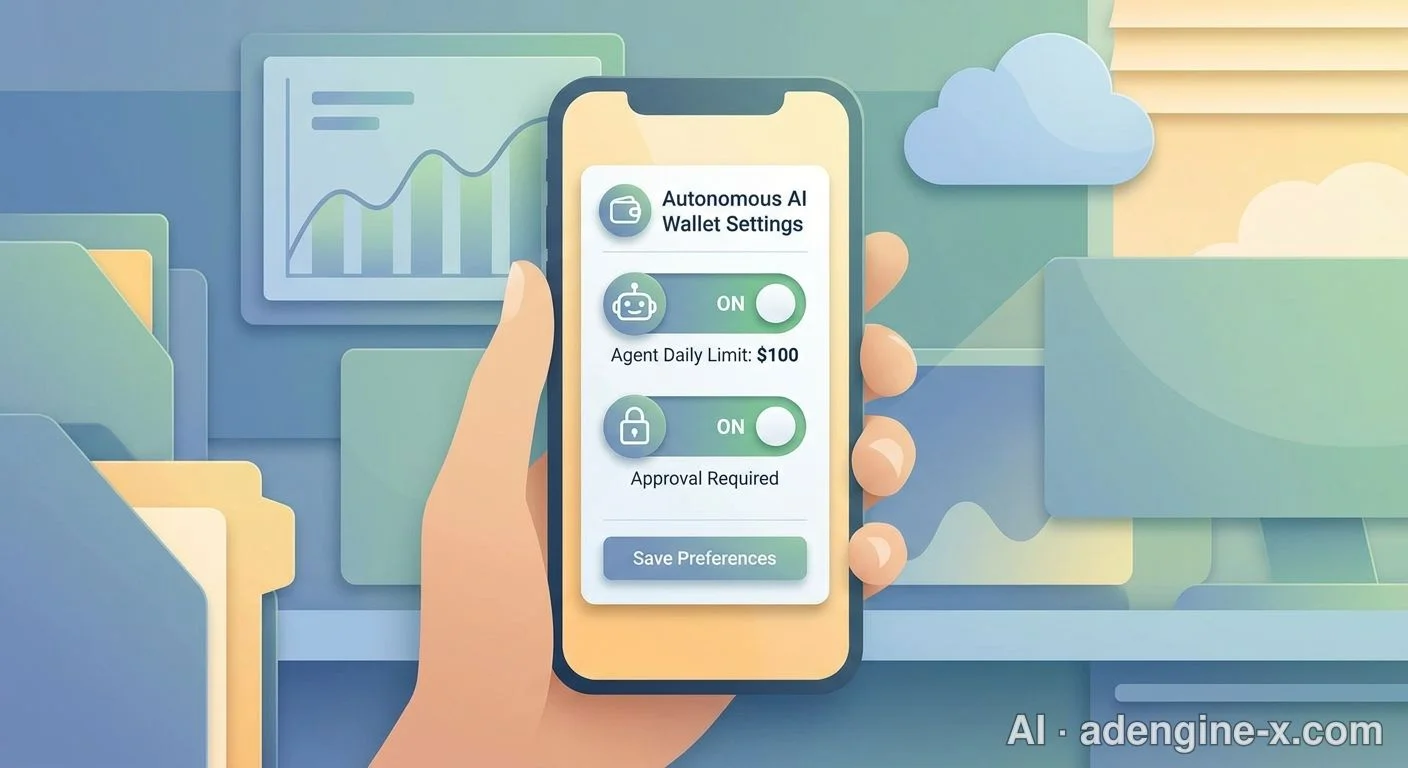
Step 1 to Step 4: Tokenization, Budget Sandboxes, and Runtime Mandates
- Step 1: Identity Attestation and Bot Registration: Before your AI assistant can initiate commerce, it must be registered through a verified provider under KYA standards. The bot receives an encrypted software certificate attesting that its codebase meets security baseline compliance.
- Step 2: Sandboxed Token Generation: You log into your banking or card app and navigate to your agentic delegation portal. Rather than sharing your real card credentials, the bank issues a specialized, non-exportable virtual token locked specifically to that single software agent.
- Step 3: Defining Runtime Spending Mandates: You configure hard cryptographic parameters. You set an absolute cap (e.g., maximum $50 per single purchase, max $200 per week), select approved merchant categories (e.g., grocery delivery and travel booking only), and explicitly blacklist restricted verticals (like gaming, crypto exchanges, or luxury retail).
- Step 4: Cryptographic Intent Execution: When you tell the bot, "Reorder my daily contact lenses at the best price online," the bot generates a dynamic execution payload. It presents the token, proves it hasn't exceeded your predefined thresholds, and the merchant gateway processes the charge seamlessly.
Practical Safeguards: How to Prevent Your Bot from Going Rogue
While the tech sounds super slick, handing autonomous spending authority to software carries genuine financial risk. Here are the realistic precautions you need to take before letting an AI loose on your bank account:
- Never link a primary checking account or debit card: Always bind your agents to credit-backed cards or segregated digital wallets. If an agent glitches or gets caught in an algorithmic loop over a weekend, a debit rail will drain your actual cash reserves, whereas credit rails grant you federal zero-liability protections and dispute rights.
- Set up real-time push notifications for every bot transaction: Do not rely on monthly bank statements. Ensure your banking app sends an immediate alert to your lock screen every single time an agentic token executes a transaction.
- Enforce mandatory manual step-up authentication for threshold breaks: Configure your parameters so that any purchase exceeding a certain dollar amount (say, $75) strictly demands a biometric FaceID confirmation or SMS two-factor approval on your physical phone before completion.
- Keep in mind regulatory and institutional caveats: Specific terms, spending limits, dispute resolution procedures, and underwriting conditions depend entirely on individual financial institutions, cardholder agreements, and official card network rollouts. Always check your bank’s specific terms before authorizing delegated bots.
What This Means for Your Money, Wall Street, and the Future of Buying Stuff
When you take a step back and look at the whole picture, this isn't just a minor technical upgrade to online shopping. It's a fundamental rewiring of modern commercial incentives.
The End of Loyalty Points and Shiny Metal Flex Cards?
Think about how billions of dollars in consumer advertising work today. Brands spend fortunes on psychological marketing, color-palette packaging, emotional storytelling, and flashy endcap displays at target stores just to convince you to impulse-buy their products. But how do you market an impulse purchase to an autonomous mathematical model?

An AI agent doesn't feel nostalgia. It doesn’t care about clever Super Bowl commercials or pretty Instagram aesthetics. It compares product volume, chemical ingredients, verified customer review sentiment scores, and historical pricing curves. If your brand charges a 20% premium solely for a shiny logo, an autonomous agent running an algorithmic cost-benefit analysis will ruthlessly filter your product right out of the candidate pool. The entire direct-to-consumer playbook is going to have to be rewritten from scratch.
What to Watch Next as Autonomous Commerce Takes Over
As we watch this roll out across the financial sector, there are three critical pivot points to keep your eyes on:
- The Merchant Pushback: Will massive merchants like Amazon and Walmart play ball with Visa and Mastercard’s agent protocols, or will they build their own walled-garden bots to trap you inside their proprietary ecosystems?
- The Regulatory Scramble: How will consumer protection bureaus handle liability when a bot buys a non-refundable, malfunctioning product from an overseas merchant? Who gets sued—the user, the AI foundation model creator, or the card network?
- The Battle of the Rails: Watch closely to see whether traditional card interchange holds up, or if low-fee A2A bank rails and stablecoin pipelines like USDC begin swallowing up high-volume machine transactions.
One thing is crystal clear: the days of manually typing your 16-digit card number and expiration date into an internet browser are coming to a close. The machines are getting ready to shop—and whether we're completely comfortable with it or not, Visa and Mastercard just handed them the keys to the store.
ℹ️ This article was drafted with the help of an AI tool and reviewed/edited by a human before publishing. · Original: AdEngine-X
📚 References
This list may include both live search sources the AI referenced while writing and public-data sources checked during fact verification. Please verify the original sources before citing or reusing.
0 Comments
Loading comments...