$1.5M 401(k) RMD Tax Impact: Key Rates, 4 Strategic Alternatives, and Roth Conversion Mechanics
(Advertisers wanted)
(Advertisers wanted)
📌 Topic & Subject
This article examines the tax implications and mechanics of Required Minimum Distributions (RMDs) for individuals holding a $1.5 million pre-tax 401(k) or Traditional IRA. It explores legislative frameworks like the SECURE Act and analyzes four strategic alternatives—Roth IRA Conversions, Qualified Charitable Distributions (QCDs), Qualified Longevity Annuity Contracts (QLACs), and the Status Quo—to help retirees manage tax bracket migration and optimize their long-term wealth decumulation.
(Advertisers wanted)
(Advertisers wanted)
📌 Table of Contents
- 1. Market Status and Capital Shift: The $1.5M 401(k) Dilemma
- 2. Technical Computation: IRS Formula and Quantitative Simulations
- 3. Core Comparative Analysis: Structural Strategies to Address RMD Exposure
- 4. Strategic Decumulation: The Systematic Roth Conversion Framework
- 5. Secondary Structural Frictions: The Broader Tax Impact
- 6. Institutional Perspectives: What Financial Analysts and Regulators Note
- 7. Technical Traps, Penalties, and Operational Execution
- 8. Advanced Decumulation Tactics and Planning Nuances
- 9. Long-Term Horizons: Legislative Risks, TCJA Sunsets, and Generational Realities
- 10. Concluding Review: Summary of Key Financial Trade-Offs
1. Market Status and Capital Shift: The $1.5M 401(k) Dilemma

Accumulating a seven-figure retirement portfolio is often celebrated as the zenith of personal financial discipline. Data compiled by Fidelity indicates that the count of '401(k) millionaires' has reached record levels, propelled by decades of compounded equity market returns across broad market indices like the S&P 500 and the Nasdaq. However, beneath this headline asset accumulation lies an institutional friction point: the transition from asset accumulation to asset decumulation under statutory mandates. For an investor entering retirement with a $1,500,000 balance in a pre-tax 401(k) or Traditional IRA, the transition from voluntary compounding to compulsory liquidation presents complex tax challenges.
The central mechanism driving this structural pivot is the Required Minimum Distribution (RMD). Defined under Internal Revenue Code provisions, the RMD is the statutory minimum sum that retirement plan participants must distribute annually once they cross a designated age threshold. While defined contribution plans allow wage earners to defer immediate compensation and capital gains taxes across multiple decades, these balances are not permanently exempt from federal taxation. The Internal Revenue Service (IRS) maintains that tax-advantaged accounts exist primarily to provide livelihood support during retirement, rather than serving as permanent, untaxed wealth-transfer vehicles. Consequently, when the statutory timeline arrives, distributions are mandated regardless of whether the account owner requires the capital to meet living expenses.
1.1. Legislative Evolution: From 70.5 to the SECURE Act Framework
For several decades, the statutory commencement age for mandatory retirement distributions remained firmly fixed at 70.5. This boundary reflected actuarial tables and labor patterns established in an earlier economic era. In response to increasing life expectancy and the rising labor force participation of older demographics, the United States Congress enacted the Setting Every Community Up for Retirement Enhancement (SECURE) Act of 2019 (SECURE Act 1.0). This legislation systematically shifted the beginning age from 70.5 to 72, effective January 1, 2020.
This framework was subsequently modified with the passage of the SECURE 2.0 Act at the end of 2022. Under SECURE 2.0, the RMD trigger age advanced to age 73 starting on January 1, 2023. The statute incorporates a secondary forward-looking escalation: individuals born on or after January 1, 1960, are expected to see their statutory distribution start age increase to age 75 beginning in 2033. While these statutory extensions allow capital to compound uninterrupted within tax-deferred wrappers for additional years, they can create a secondary structural tension by enlarging the underlying account balances subjected to mandatory distribution factors.
1.2. The Mechanics of the Pre-Tax Tax Cascade
The operational friction of an RMD stems from its tax classification. Unlike capital gains generated within a taxable brokerage account—which qualify for preferential statutory rates of 0%, 15%, or 20%—every dollar distributed from a traditional pre-tax 401(k) or Traditional IRA is categorized as ordinary income. An annual forced distribution of approximately $50,000 to $90,000 superimposed onto an existing retirement income baseline (such as corporate pensions, annuity payouts, and investment interest) can cause bracket migration.
This income surge triggers secondary consequences throughout a retiree's balance sheet. Modified Adjusted Gross Income (MAGI) increases can push a household into higher marginal federal tax tiers, activate phase-outs for various statutory credits, trigger surcharges on Medicare premiums via Income-Related Monthly Adjustment Amounts (IRMAA), and convert up to 85% of Social Security benefits into federally taxable income. This multi-tiered structural erosion is widely known among tax practitioners as the retirement 'tax cascade.'
2. Technical Computation: IRS Formula and Quantitative Simulations
Accurate strategic planning requires understanding the exact mathematical mechanics defined by the IRS. The annual mandatory distribution obligation is calculated using account values and life expectancy divisor factors published in IRS regulatory schedules.

2.1. The Divisor Formula (IRS Publication 590-B)
Under statutory guidelines detailed in IRS Publication 590-B, the annual distribution figure is determined by dividing the fair market value of all pre-tax accounts as of December 31 of the preceding tax year by a designated distribution period found in the Uniform Lifetime Table (Table III):
$$\text{Annual RMD} = \frac{\text{Total Account Balance as of Dec 31 of Prior Year}}{\text{IRS Life Expectancy Divisor (Uniform Lifetime Table)}}$$
The divisor factor decreases with each advancing year, reflecting diminishing actuarial life expectancy. As the denominator systematically contracts, the percentage of the remaining portfolio mandated for distribution accelerates annually, creating an upward distribution slope over time.
2.2. Quantitative Trajectory: $1.5 Million Balance Across Decades
To evaluate the quantitative burden, consider a retiree holding a constant baseline balance of $1,500,000 across their distribution lifecycle (or assuming investment gains roughly offset distributions and fees to maintain the $1.5M principal base):
- Age 73 (Divisor 26.5): $1,500,000 ÷ 26.5 = $56,603.77 (Baseline mandatory distribution rate: ~3.77%)
- Age 74 (Divisor 25.5): Assuming an account value of $1,515,000 reflecting 5% growth prior to distribution, the calculated obligation equals $59,411.76
- Age 75 (Divisor 24.6): Standardized $1.5M model yields $60,975.61 (Baseline rate: ~4.06%)
- Age 80 (Divisor 20.2): Standardized $1.5M model yields $74,257.43 (Baseline rate: ~4.95%)
- Age 85 (Divisor 16.0): Standardized $1.5M model yields $93,750.00 (Baseline rate: ~6.25%)
- Age 90 (Divisor 12.2): Standardized $1.5M model yields $122,950.82 (Baseline rate: ~8.20%)
These computations demonstrate that without structural decumulation planning, an account holder can see required distributions potentially increase significantly between age 73 and age 85, forcing substantial liquidations into high income tax brackets.
3. Core Comparative Analysis: Structural Strategies to Address RMD Exposure
Account owners evaluate four primary financial paths to manage or mitigate the RMD tax burden. The selection of an optimal method may depend on retirement timing, liquidity preferences, and broader financial goals. The comparative metrics below highlight the primary operational attributes of each approach:
| Strategy Option | Core Mechanism | RMD Reduction Capacity | Tax Impact & Recognition | Primary Drawbacks & Cautions |
|---|---|---|---|---|
| 1. Roth IRA Conversion ("The Structural Standard") | Systematic transfer of pre-tax 401(k)/IRA assets to Roth status during low-bracket years (Ages 60–72). | Permanent baseline elimination. Roth IRAs generally feature no statutory RMD mandates during the owner's lifetime. | Accelerates ordinary income tax liability to the calendar year of conversion; subsequent earnings and withdrawals are typically tax-free. | Requires liquid, non-retirement cash reserves to cover frontloaded tax liabilities without triggering early liquidation penalties. |
| 2. Qualified Charitable Distribution (QCD) ("Philanthropic Offset") | Direct institutional transfer of IRA assets to a qualifying 501(c)(3) nonprofit organization (Eligible at age 70.5+). | Direct annual offset. Offsets required distribution dollar-for-dollar up to the statutory ceiling ($105,000 in 2024, indexed to $111,000 for the 2026 tax year). | Distributed funds are fully excluded from Adjusted Gross Income (AGI), preventing tax bracket creep and IRMAA adjustments. | Disbursed principal cannot be redirected toward personal living expenses or private heirs; limited strictly to qualified charitable targets. |
| 3. Qualified Longevity Annuity Contract (QLAC) ("Deferral Expansion") | Carving out retirement balances (up to the statutory limit of $200,000, indexed to $210,000 for 2025–2026) into a deferred income annuity running to age 85. | Short-to-medium reduction. Allocated capital is carved out from calculation balances until payments commence. | Defers tax recognition until distributions begin at advanced age (up to age 85), where payouts are taxed as ordinary income. | Substantial sacrifice of capital liquidity; underlying assets are locked, and premature death can result in yield drag if return-of-premium riders are excluded. |
| 4. Status Quo / Inertia ("Baseline Default") | Maintaining pre-tax positions without pre-emptive decumulation until age 73 statutory initiation. | Zero structural mitigation. Account balance continues exposure to mandatory compounding and statutory divisors. | Full exposure to statutory ordinary income brackets; compounding increases tax liability, driving Medicare surcharges and benefit taxation. | Forces unwanted distributions into potentially higher marginal tax brackets, resulting in significant drag on generational wealth transfer. |
*Note: Precise terms, limits, and product mechanics are governed by official IRS notices, institutional plan guidelines, and individual financial evaluations.
4. Strategic Decumulation: The Systematic Roth Conversion Framework
Among wealth managers and institutional tax planners, deliberate and systematic Roth conversion is widely recognized as a foundational tool for addressing structural RMD issues. Unlike tactical offsets that apply only to specific calendar years, an executed Roth conversion addresses the root cause: the taxable principal base within the pre-tax account.
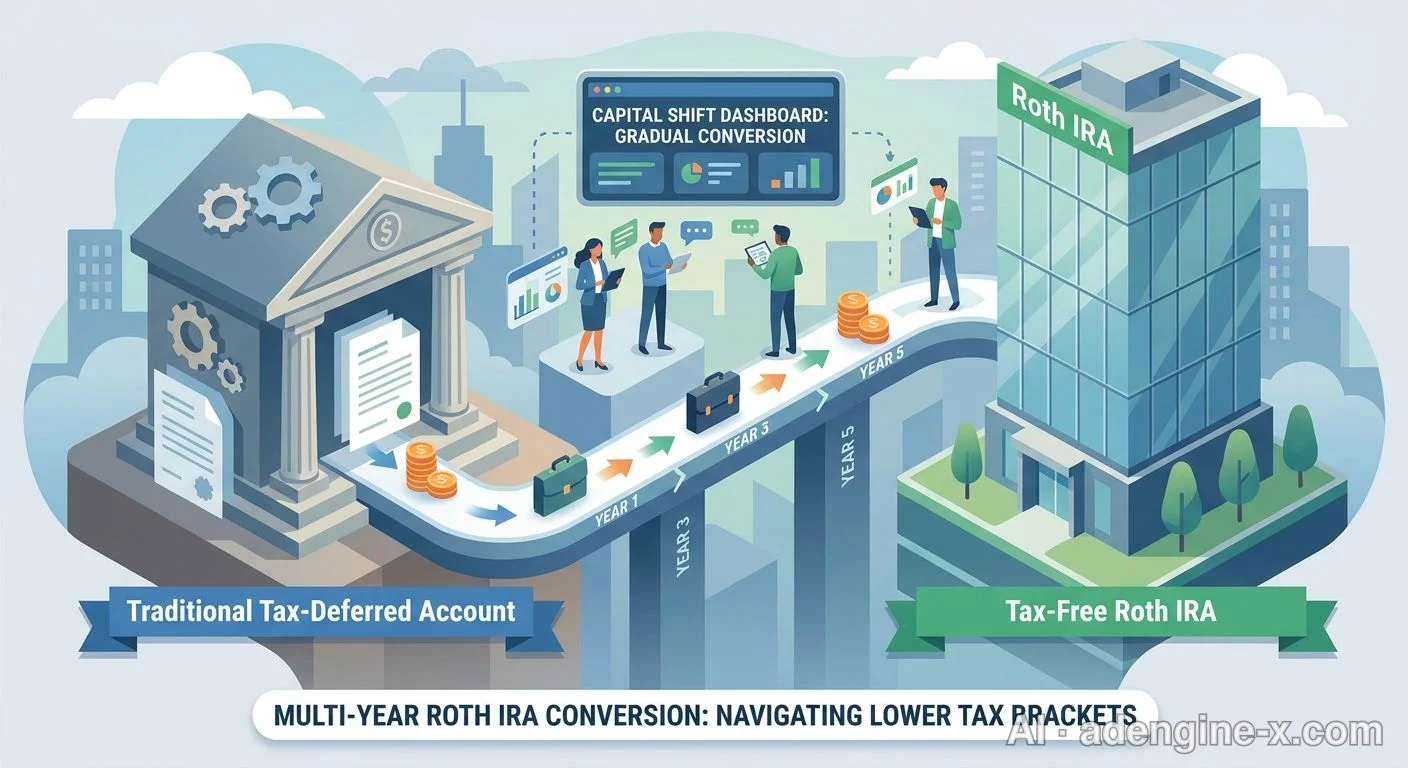
4.1. The Strategic Bridge: Exploiting the 'Tax Valley'
The mathematical foundation for executing a Roth conversion often rests on multi-year tax bracket arbitrage. When a wage earner leaves the workforce, their earned income drops sharply. For individuals retiring around age 60 to 65 who postpone the start of Social Security benefits until full retirement age or age 70, a multi-year low-income phase emerges. This window between employment cessation and the initiation of statutory pensions and RMDs is known as the 'tax valley.'
During this period, a retiree's taxable income may drop into modest federal brackets (such as 10% or 12%). If an individual takes no action, entering age 73 with a $1,500,000 pre-tax account will abruptly push their income upward. By executing calibrated partial conversions each year during the tax valley, the account holder can systematically distribute portions of their $1,500,000 balance at predictable rates—filling the 12%, 22%, or 24% marginal tax brackets—and transfer the funds into a Roth account.
4.2. Conversion Math: Calculating the Long-Term Advantage
Consider an account owner converting $60,000 annually over an eight-year span from age 62 to 70. By recognizing that income within favorable tax brackets and covering the tax liabilities with after-tax brokerage cash, the individual transfers nearly $480,000 of principal out of the pre-tax environment.
Because Roth IRAs are exempt from lifetime RMD requirements under Internal Revenue Code rules, every dollar transferred permanently decreases the future December 31 balance that the IRS uses to calculate distributions at age 73. At that point, the reduced pre-tax balance yields a substantially smaller mandatory distribution. The transferred capital continues to compound tax-free within the Roth IRA, available for tax-free withdrawals or preserved for generational transfer.
5. Secondary Structural Frictions: The Broader Tax Impact
The impact of taking an unmitigated $56,603 distribution from a $1.5 million balance at age 73 extends beyond the federal income tax bracket. The distribution ripples through several interconnected elements of retirement finance.
5.1. Medicare IRMAA Surcharges
Medicare Part B (medical insurance) and Part D (prescription drug coverage) premium structures include progressive pricing tiers determined by income. Under the Income-Related Monthly Adjustment Amount (IRMAA) rules, the Social Security Administration evaluates a tax filer's Modified Adjusted Gross Income (MAGI) using tax returns from two years prior.
Crossing statutory income tier thresholds—such as single filer boundaries around $103,000 or married filing jointly thresholds around $206,000 (applicable for 2024; adjusted to $109,000 and $218,000 respectively for 2026)—by even a single dollar triggers a cliff surcharge. An RMD of $56,603 added to existing investment interest, dividends, and pensions can easily cross these thresholds, resulting in substantial monthly premium surcharges per individual. For a married couple, this can mean thousands of dollars in added annual healthcare expenses deducted directly from their Social Security checks.
5.2. The Social Security 'Tax Torpedo'

Federal taxation of Social Security benefits is determined by a statutory metric termed 'Provisional Income,' calculated as follows:
$$\text{Provisional Income} = \text{Modified AGI} + \text{Tax-Exempt Interest} + 50\%(\text{Annual Social Security Benefits})$$
The statutory thresholds have generally remained unindexed for inflation since their introduction: for married couples filing jointly, provisional income exceeding $44,000 causes up to 85% of their Social Security benefits to be classified as ordinary taxable income (the threshold sits at $34,000 for single filers). A mandatory $56,603 RMD from a $1.5 million 401(k) easily surpasses these limits on its own. The addition of mandatory distributions can quickly trigger the upper 85% taxable tier on Social Security benefits, increasing the effective marginal tax rate across that income band.
6. Institutional Perspectives: What Financial Analysts and Regulators Note
Prominent figures across retirement research and financial advisory institutions have pointed to the structural challenges built into traditional retirement decumulation planning.
Retirement research analysts emphasize that many retirees approach decumulation with the vast majority of their wealth concentrated in tax-deferred accounts. Once required minimum distributions begin at age 73, account holders frequently encounter an abrupt tax cliff regardless of actual living expenses, making proactive multi-account diversification an essential early-retirement objective.
Tax specialists frequently point out that the RMD framework represents the federal government finally collecting on decades of tax deferrals. While retirees often view a seven-figure retirement balance as fully theirs, a significant fraction is effectively owed to federal and state tax authorities, underscoring the advantage of managing the liability before statutory mandates begin.
Industry wealth managers similarly observe that decumulation requires looking beyond year-to-year withdrawal figures. Strategic financial planning focuses on designing an efficient multi-year withdrawal sequence across taxable, tax-deferred, and Roth accounts to capitalize on lower-income intervals prior to mandatory distributions.
The IRS outlines the core regulatory perspective in official materials such as Publication 590-B. The guidance emphasizes that preferential tax-deferral statuses are designed to support retirement living needs. Consequently, statutory distribution rules are enforced to ensure that these accounts are not used solely for indefinite tax sheltering or unconstrained estate planning.
7. Technical Traps, Penalties, and Operational Execution
Managing an account through the decumulation phase requires adhering to precise administrative schedules and account aggregation rules. Overlooking these mechanics can result in significant financial penalties.
7.1. The Required Beginning Date (RBD) and Calendar Dynamics
An individual reaching age 73 is generally required to take their initial RMD by their Required Beginning Date (RBD), defined by statute as April 1 of the calendar year following the year they reach age 73. For example, an individual turning 73 during 2026 can defer their initial distribution until April 1, 2027.
However, this deferral carries a tax trap: deferring the initial distribution into the subsequent calendar year requires taking two full RMDs in that single tax year (the deferred Year 1 distribution by April 1, and the mandatory Year 2 distribution by December 31). Combining two six-figure distributions into a single tax return can push the account owner into much higher tax brackets and trigger higher Medicare IRMAA surcharges. In practice, financial planners typically advise clients to complete the initial distribution by December 31 of the year they reach age 73 to avoid the adverse tax consequences of taking two distributions in a single calendar year.o avoid doubling up distributions.
7.2. Account Aggregation Restrictions
Rules governing the aggregation of distributions differ based on account type:
- Traditional IRAs: Account owners holding multiple Traditional, SEP, or SIMPLE IRAs calculate the mandatory distribution for each account separately, but they can aggregate the total dollar amount and distribute it from any single IRA or combination of IRAs under their ownership.
- Employer-Sponsored 401(k) and 403(b) Plans: 401(k) accounts do not share this flexibility. An investor holding balances across multiple former employer 401(k) plans cannot aggregate these figures or withdraw the combined balance from a single account. Each 401(k) plan requires an independent calculation, and the exact distribution must be taken directly from that specific plan. Failure to process a distribution from each plan constitutes a compliance violation, even if the total dollar amount was withdrawn from an IRA.
7.3. SECURE 2.0 Excise Tax Structure
Failing to withdraw the full mandatory distribution amount incurs an IRS excise tax. Historically, the penalty for an unfulfilled RMD stood at an onerous 50% of the undistributed shortfall. The SECURE 2.0 Act lowered this statutory excise tax to 25%, effective for tax years beginning after 2022. Furthermore, if the shortfall is corrected and distributed within a designated statutory correction window (typically within two years) alongside an amended return, the excise penalty is reduced to 10%.
8. Advanced Decumulation Tactics and Planning Nuances
Experienced financial planners use several specialized statutory provisions to reduce mandatory distributions and lower ongoing tax exposure.
8.1. Early Qualified Charitable Distributions (The Age 70.5 Window)
While the SECURE Acts pushed the RMD starting age to 73 and eventually 75, Congress did not change the statutory eligibility age for Qualified Charitable Distributions (QCDs). Under Internal Revenue Code Section 408(d)(8), account owners become eligible to execute QCDs directly to 501(c)(3) charities upon reaching age 70.5.
This creates a strategic multi-year opportunity. From age 70.5 until age 73, account owners can redirect recurring charitable giving—such as donations to religious institutions, higher education, or philanthropic funds—directly from their pre-tax Traditional IRA instead of using taxable bank accounts. These distributions are entirely excluded from Adjusted Gross Income, reducing the underlying December 31 balance before mandatory RMD calculations begin at age 73.

8.2. The Joint Life Expectancy Table (Table II) Exception
Most account holders calculate their distributions using the standard Uniform Lifetime Table (Table III). However, if an account owner's spouse is the sole primary beneficiary of the account for the entire distribution calendar year and is more than 10 years younger than the account owner, the regulations permit using the Joint Life and Last Survivor Expectancy Table (Table II).
Because the life expectancy factors in Table II reflect two lives—one considerably younger—the calculated divisor is significantly larger. For example, a 73-year-old account owner with a 60-year-old spouse uses a divisor of 30.5 rather than the standard 26.5 factor. Applied against a $1,500,000 balance, this reduces the initial distribution obligation from $56,603 to $49,180. This lowers the mandatory distribution by $7,423 in that year alone, directly reducing the associated income tax and preserving more capital within the account.
8.3. Roth Conversion 5-Year Holding Rules
Executing an early conversion strategy requires tracking the statutory five-year holding periods. Under Treasury regulations, each separate conversion tranche is subject to a 5-tax-year holding requirement before converted principal can be accessed penalty-free if the owner is under age 59.5. Additionally, the Roth account itself must have been open for at least five full tax years for subsequent investment earnings to be distributed as fully qualified, tax-exempt income after age 59.5. Establishing a Roth IRA early ensures that conversion assets can be accessed without unexpected administrative hurdles or penalties.
9. Long-Term Horizons: Legislative Risks, TCJA Sunsets, and Generational Realities
Retirement decumulation planning cannot rely on static assumptions; it must adapt to evolving legislative landscapes and changing intergenerational wealth transfer rules.
9.1. The 2025 Tax Cuts and Jobs Act (TCJA) Sunset Risk
A key consideration for immediate Roth conversion planning is the potential expiration of individual tax provisions enacted under the 2017 Tax Cuts and Jobs Act (TCJA). Many of these statutory tax rate reductions are scheduled to sunset after December 31, 2025. Without legislative intervention or extension, individual tax rates are set to revert to pre-2018 levels:
- The 12% bracket is scheduled to return to 15%
- The 22% bracket is scheduled to return to 25%
- The 24% bracket is scheduled to return to 28%
- The 32% bracket is scheduled to return to 33%
- The top 37% bracket is scheduled to return to 39.6%
For investors holding $1,500,000 in pre-tax assets, this potential rate increase makes conversions during lower-rate periods an attractive planning option. Converting balances within current 22% or 24% brackets locks in those tax rates before potentially higher statutory rates take effect.
9.2. Age 75 Deferral: Compounding vs. Bracket Pressure
For individuals born in 1960 or later, SECURE 2.0 extends the RMD start age to 75 beginning in 2033. While this two-year delay provides a longer runway for portfolio growth, it can present an unexpected challenge. An account left to grow unaddressed from age 65 to age 75 could easily expand from $1.5 million to beyond $2.5 million under favorable market conditions. At age 75, the initial distribution factor is 24.6. A 4.06% distribution on a $2.5 million account results in a required first-year ordinary income distribution of $101,626. Allowing pre-tax balances to compound without an intermediate decumulation strategy can ultimately compress larger distributions into higher tax brackets later in life.
9.3. The 10-Year Beneficiary Rule (SECURE Act 1.0)
The estate planning landscape for retirement accounts was substantially reshaped by the elimination of the traditional 'Stretch IRA' under the original SECURE Act. Previously, non-spouse beneficiaries inheriting a Traditional IRA could stretch mandatory distributions over their individual actuarial life expectancies, keeping annual taxable amounts relatively small.
Under current law, most non-eligible designated beneficiaries (such as adult, non-disabled children) must fully liquidate the inherited retirement balance by December 31 of the tenth year following the original owner's death. If a retiree leaves a $1.5 million pre-tax 401(k) to adult children who are in their peak earnings years (typically ages 40 to 60), the requirement to absorb that $1.5 million into their taxable income over a single decade can push their earnings into the highest federal and state tax brackets. By executing Roth conversions during their own retirement years, the original account owner pays taxes at their lower retirement rates, allowing heirs to inherit a Roth IRA that can compound tax-free for an additional ten years and be distributed entirely free of federal income tax.
10. Concluding Review: Summary of Key Financial Trade-Offs
A $1.5 million 401(k) or Traditional IRA balance highlights a fundamental reality of retirement finance: accumulation efficiency does not automatically translate into decumulation efficiency. The transition from tax deferral to mandatory distribution requires understanding complex, interrelated tax mechanics. Without proactive management, statutory distributions can increase marginal tax brackets, trigger Medicare IRMAA surcharges, and increase the taxable portion of Social Security income.
Managing these outcomes requires an integrated, multi-year plan. Evaluating systematic Roth conversions during the early-retirement 'tax valley,' pairing giving goals with Qualified Charitable Distributions after age 70.5, and monitoring legislative changes like the TCJA sunset enable account holders to protect their assets from unnecessary tax erosion. Transitioning from passive accumulation to structured decumulation helps retirees retain control over their wealth, preserve portfolio value, and optimize generational wealth transfer.

*Regulatory and Policy Disclosure: Tax codes, contribution thresholds, and statutory age parameters remain subject to legislative adjustments and IRS regulatory interpretations. Precise individual execution requires reviewing personal portfolio parameters, state tax statutes, and professional guidance through qualified financial, accounting, or estate planning advisors before implementing structural conversion strategies.
ℹ️ This article was drafted with the help of an AI tool and reviewed/edited by a human before publishing. · Original: AdEngine-X
📚 References
This list may include both live search sources the AI referenced while writing and public-data sources checked during fact verification. Please verify the original sources before citing or reusing.
0 Comments
Loading comments...