SpaceX Stock Analysis 2026: Why Wall Street Targets $280 While Bears Warn Valuation Is Beyond Silly
(Advertisers wanted)
(Advertisers wanted)
📌 Topic & Subject
This article provides a 2026 financial and strategic analysis of SpaceX (NASDAQ: SPCX) following its historic $75 billion initial public offering. It examines market dynamics, valuation multiples, and the intense debate between Wall Street bulls targeting up to $800 and bears warning that the $1.91 trillion enterprise value is excessively high.
(Advertisers wanted)
(Advertisers wanted)
📌 Table of Contents
- 1. Market Dynamics and the Mechanics of the Historic $135 IPO
- 2. Quantitative Financial Performance and Key Metrics Comparison
- 3. The Bull Case: Physical AI Infrastructure and Orbital Monopolies
- 4. The Bear Case: Valuation Realities and Multi-Trillion-Dollar Arithmetic
- 5. Behind the Corporate Veil: Financial Engineering and Operational Pivots
- 6. Consumer and Enterprise Impact: The Starlink Ecosystem and Unit Economics
- 7. Practical Trading Guide: Float Mechanics, Lock-Ups, and Index Tracking
- 8. Strategic Outlook: Multi-Billion-Dollar Catalysts and Operational Risks
Grab a cup of coffee and settle in. If you have been monitoring the tape on Wall Street throughout the summer of 2026, you already know that the historic public debut of Elon Musk's Space Exploration Technologies Corp. (NASDAQ: SPCX) has rewritten the financial playbook. After 24 years of operating as the crown jewel of Silicon Valley and aerospace private capital, SpaceX broke open the public markets by executing a $75 billion initial public offering. Today, the stock trades in the $148 to $150 channel—holding roughly 10% to 11% above its fixed IPO offer price of $135.00 per share, commanding an enterprise value hovering near $1.91 trillion.
Yet, behind this massive scale lies one of the fiercest theoretical tug-of-wars in modern equity analysis. On one side, institutions like Oppenheimer maintain aggressive price targets climbing to $280, while Raymond James projects blue-sky territory at $800, driven by the monetization of Starlink and orbital artificial intelligence compute clusters. On the opposite side of the ledger, veteran market allocators such as Mark Yusko call the prevailing multiple “beyond silly,” and NYU Stern professor Scott Galloway models fair value down at $10 to $30 per share. To understand where the risk-reward ratio truly rests, we must dissect the operational metrics, technical float constraints, capital expenditure trajectories, and unit economics without emotion.
1. Market Dynamics and the Mechanics of the Historic $135 IPO
To evaluate SPCX with precision, we must first analyze the structural mechanics of its June 12, 2026 debut. Rather than providing an indicative pricing range to institutional order books—the standard practice for multi-billion-dollar listings—the underwriting syndicate established a fixed pricing structure at $135.00 flat across 555.6 million newly minted common shares. This decision secured $75 billion in gross proceeds, setting an all-time record for total capital raised in a single corporate public offering.

The secondary trading began with an explosive technical squeeze. Opening at $150.00—an immediate 11.11% premium to offer price—institutional fear of missing out (FOMO) combined with retail buying pressure drove the tape to an all-time intraday high of $225.64. At that zenith, SpaceX briefly touched a market capitalization of nearly $3 trillion. However, the subsequent reality check of severe capital expenditure requirements, consolidated operating drag from the xAI integration, and the psychological overhang of upcoming insider lock-up expirations triggered an aggressive 53.5% retracement toward an intraday low of $104.80.
The Current Equilibrium: Technical Base at $148–$150
As of September 2026, price action has consolidated into a well-defined technical accumulation band between $148 and $150. This price level represents a durable 10% to 11% premium over the initial $135.00 pricing watermark. Long-term institutional accounts view this range as an effective baseline of support, stepping in systematically whenever intraday dips breach the $140 threshold. The trading volume profile indicates steady absorption of early shareholder liquidation, setting up the asset for its next fundamental valuation catalyst.
Structural Float Economics and Dual-Class Governance
One critical technical metric every institutional equity desk must account for is the exceptionally tight public float. Out of approximately 12.9 billion total fully diluted shares outstanding, the initial free float distributed to the open market was restricted to approximately 4.0% to 5.0%. This structural scarcity creates a natural supply-demand imbalance, amplifying upside velocity when demand surges and accelerating drawdowns when institutional volume exits.
Furthermore, the corporate governance architecture enforces asymmetric voting control through a dual-class share framework. Class A common shares carry one vote per share, whereas Class B shares carry ten votes per share. Elon Musk retains approximately 12% of Class A common stock and an overwhelming 94% of Class B common stock. This distribution grants him absolute operational and strategic governance over the board of directors, rendering activist investor interventions structurally ineffective.
The Balance Sheet Paradox: $100B Cash and the $25B Debt Issuance
A notable balance sheet development materialized just two weeks after the closing of the listing. Despite holding an aggregate cash balance exceeding $100 billion post-IPO, corporate treasury executed a mammoth $25 billion debt offering in the corporate bond market. From an enterprise capital management perspective, this represents aggressive leverage optimization. Taking advantage of the company's peak corporate debt ratings and institutional demand immediately following the equity debut, SpaceX locked in long-term non-dilutive debt financing at attractive fixed coupons to pre-fund multi-year infrastructure commitments in Texas and Louisiana.
2. Quantitative Financial Performance and Key Metrics Comparison
Evaluating SpaceX purely as an aerospace hardware contractor yields a fundamentally distorted valuation. Financial modeling requires segmenting the top-line performance across heavy launch logistics, Starlink broadband subscription recurring revenue, and the capital-intensive compute initiatives introduced via the xAI consolidation. The financial data filed for fiscal year 2025 and preliminary forecasts for 2026 reveal both extraordinary top-line momentum and significant near-term accounting headwinds.
In fiscal year 2025, consolidated revenues reached $18.674 billion. However, under standard GAAP reporting, the entity recorded a net loss of $4.937 billion. The underlying driver of profitability was the Starlink satellite communications division, which generated $11.387 billion in revenue and delivered $4.423 billion in operating profit, supported by an active global user base that surpassed 10.3 million subscribers by early 2026. Conversely, the advanced research division—anchored by the integrated xAI operations—recorded an annual operating burn of -$6.355 billion due to aggressive model training, infrastructure buildouts, and engineering compensation.
Enterprise Run-Rate Projections for 2026–2027
Looking ahead, the top-line trajectory is accelerating rapidly. The annualized run-rate revenue calculated from Q2 2026 operational filings reached $31.0 billion. Consensus equity research models project this run-rate will scale past the $100 billion annual benchmark by late 2027. This acceleration assumes regular commercial cadence of the next-generation Starship launch system, expanded enterprise defense communications, direct-to-cell telecom connectivity, and initial orbital compute deployments.
Valuation Multiple Benchmarking
At the current share price of roughly $149.00, the market capitalization sits between $1.91 trillion and $1.95 trillion. Based on projected 2026 enterprise revenues, SPCX is valued at approximately 70 times forward sales, while trading at roughly 265 times 2025 adjusted EBITDA. By point of comparison, high-growth data enterprise Palantir Technologies traded at approximately 225 times 2025 EBITDA during comparable growth phases. Such elevated multiples imply that the equity market is pricing in flawless execution over the next five to seven fiscal years.
The comparative matrix below benchmarks the structural operational parameters, cost structures, growth profiles, and valuation multiples of SpaceX against its primary competitive peer groups across traditional aerospace defense, emerging private launch competitors, and terrestrial hyperscale technology conglomerates.
| Analytical Metric | SpaceX (NASDAQ: SPCX) | Legacy Aerospace (Boeing, LMT, ULA) | Emerging Launchers (Rocket Lab, Stoke) | Hyperscalers & Satcom (Amazon Kuiper, MSFT) |
|---|---|---|---|---|
| Core Business Model | Reusable launch hardware + Starlink broadband + orbital AI compute infrastructure | Cost-plus government procurement contracts, defense rocketry, and aviation | Small-to-medium payload dedicated launch and sub-assembly manufacturing | Terrestrial cloud data centers paired with emerging LEO broadband constellations |
| Payload Unit Economics | Targeting 90% reduction in orbital delivery cost per kg via complete Starship reuse | Expendable hardware architectures costing hundreds of millions per mission | Medium-lift payloads (e.g., Neutron); competitive for low-mass customized orbits | Lacks internal launch capacity; dependent on third-party commercial launch charters |
| Key Growth Vector | 10.3M+ Starlink subscriber base + Cursor AI integration + orbital data centers | Indexed to low-single-digit federal defense spending allocations and contract renewal | Capturing secondary commercial small-sat launch backlogs and satellite buses | Enterprise cloud scaling, LLM hosting, and telecom enterprise joint ventures |
| Valuation Multiples | P/S ~70x (2026E), EV/EBITDA ~265x (2025 adj.) | P/S 1.2x–2.0x, EV/EBITDA 12x–18x | P/S 15x–30x, negative or negligible EBITDA multiples | P/S 8x–12x, EV/EBITDA 20x–30x |
| Primary Risk Factors | Massive CapEx burn, 4% float volatility, and Starship catch-and-reuse cadence risks | Severe quality assurance failures, program delivery delays, administrative overhead | Capital availability constraints, launch cadences trailing SpaceX by orders of magnitude | Orbital frequency coordination (ITU) delays, massive multi-year satellite CapEx |
3. The Bull Case: Physical AI Infrastructure and Orbital Monopolies
Wall Street equity research desks assigning buy ratings to SpaceX are not evaluating the company merely as a satellite operator or a government freight carrier. The institutional thesis advanced by Oppenheimer, Raymond James, and JPMorgan treats the firm as an infrastructure monopoly capable of bypassing terrestrial limits on energy, telecommunications, and high-performance computing.
Timothy Horan's $280 Target: The Convergence of Compute and Orbital Real Estate
Five-star senior analyst Timothy Horan at Oppenheimer maintains an ‘Outperform’ rating on SPCX, having raised his price objective from $250 to $280 per share—representing an upside target of more than 85% above current levels. Horan's quantitative model is anchored on physical infrastructure velocity, arguing that SpaceX has the ability to deploy compute infrastructure faster than competitors and leverage its platform and data to advance proprietary AI models ahead of traditional hyperscalers.
Horan's thesis highlights two critical elements: the strategic corporate acquisition of AI coding engine Cursor, and the upcoming deployment of next-generation NVIDIA Rubin architecture chipsets within orbital computing platforms. By moving high-density inference and processing hardware into low Earth orbit, SpaceX aims to mitigate the growing terrestrial power bottlenecks facing land-based data center utilities.

Brian Gesuale's Ultra-Bullish $800 Forecast
At the top of the institutional price distribution, Brian Gesuale of Raymond James maintains an $800 price target, implying roughly 434% appreciation from current levels. Gesuale frames SpaceX not as an equity asset competing for standard multiples, but as a foundational industrial infrastructure platform for the 21st century. In this framework, SpaceX's functional monopoly on reliable, low-cost orbital access enables it to tax all subsequent commerce conducted between Earth and low Earth orbit, ranging from sovereign defense intelligence arrays to commercial telecom backbones.
Starship Unit Economics: Jeffrey Wlodarczak and Doug Anmuth
At Pivotal Research Group, analyst Jeffrey Wlodarczak targets a $220 share price, equivalent to an enterprise valuation of nearly $3 trillion. His model focuses directly on the fully reusable Starship architecture, arguing that achieving structural reusability of 20 to 50 flights per vehicle with rapid turnaround could lower launch costs by roughly 90% and unlock expanded orbital computing and connectivity markets.
Echoing this stance, Doug Anmuth of JPMorgan holds an overweight posture with a $240 price target. Anmuth points to the integration of Grok and the Cursor acquisition as key catalysts that strengthen SpaceX's enterprise AI capabilities and support its multi-year monetization roadmap.
4. The Bear Case: Valuation Realities and Multi-Trillion-Dollar Arithmetic
Despite the technological achievements of Starbase and Hawthorne, seasoned capital allocators urge significant caution. The fundamental critique does not target SpaceX's engineering credentials, but rather the pricing multiples implied by its current enterprise valuation. When an enterprise reaches a $1.92 trillion baseline while absorbing billions in net losses, the margin of safety narrows considerably.
Mark Yusko's Critique: The Mathematical Problem of Scale
Mark Yusko, Founder and Chief Investment Officer of Morgan Creek Capital, delivered an uncompromising critique across institutional financial media, categorizing the current $2 trillion market valuation as “beyond silly.” Yusko's thesis rests on macroeconomic and mathematical scale, noting that for investors to achieve a standard 10x venture return, SpaceX would need to expand into a $20 trillion market capitalization—equivalent to roughly half the projected U.S. economy over the next decade—which he characterized as mathematically impossible.

Yusko further analogized the technical listing conditions to speculative memetic asset distributions, comparing the market behavior to Dogecoin. He argued that with insiders and executive management controlling roughly 95% of aggregate equity, floating a narrow 4% slice to the secondary market creates synthetic price inflation that transfers long-term valuation risk to benchmark-tracking passive index funds.
Scott Galloway's $10–$30 Price Realization Model
Scott Galloway, Professor of Marketing at the NYU Stern School of Business, voiced an equally severe assessment during recent commentary. Galloway contends that under normalized aerospace and enterprise technology valuation models, fair equity value sits between $10 and $30 per share—significantly below the prevailing tape, arguing that the elevated valuation is driven by financial engineering, passive index fund inflows, and an artificially tight float rather than cash flow fundamentals.
Galloway notes that forced passive allocation rules, combined with retail trading enthusiasm, decoupled the asset from conventional cash-flow-discount modeling. When capital expenditure cycles peak and enterprise balance sheets face debt service obligations, he warns that structural re-ratings can be swift and severe.
5. Behind the Corporate Veil: Financial Engineering and Operational Pivots
Examining the path to the June 2026 listing reveals strategic corporate adjustments executed within the executive tier of SpaceX. These maneuvers transformed the company from a capital-intensive defense vendor into a vertically integrated AI and telecom conglomerate.
The 4,400 Internal Millionaires: Hawthorne to Boca Chica

The public listing created unprecedented wealth distribution throughout the company's rank-and-file workforce. Approximately 4,400 employees became equity millionaires on paper. Unlike standard corporate IPOs where stock distributions remain confined to executive directors, SpaceX historically distributed options and incentive stock units broadly. Technicians working Starbase manufacturing lines in Boca Chica, cleanroom integration specialists in Hawthorne, and long-tenured culinary and facilities staff saw equity compensation packages transform into liquid fortunes. Approximately 400 early personnel now hold stakes valued in excess of $100 million each.
Consolidation of xAI and the Cursor Transaction
The decisive strategic catalyst justifying a multi-trillion-dollar valuation multiple was the internal consolidation of xAI and the subsequent integration of the developer platform Cursor. Prior to this corporate reorganization, market analysts viewed SpaceX through the lens of capital-intensive aerospace multiples (15x to 30x EV/EBITDA). By folding xAI's intellectual property, proprietary models, and compute requirements directly into the operational infrastructure of SpaceX, management bridged heavy industrial manufacturing with hyper-scalable artificial intelligence software.
Musk pitched institutional accounts on an unconventional vision: land-based AI clusters will soon encounter regional grid capacity limitations. Grounded by real estate zoning, cooling limits, and electrical infrastructure bottlenecks, future compute clusters can theoretically be launched directly into low Earth orbit on Starship flights, powered continuously by direct solar irradiance and cooled radiatively in vacuum. This narrative allowed underwriting banks to apply AI hyperscaler software multiples to physical rocket manufacturing lines.
6. Consumer and Enterprise Impact: The Starlink Ecosystem and Unit Economics
For millions of global end-users, the financial success of SpaceX is measured directly by the performance and accessibility of the Starlink satellite network. The communications network has fundamentally disrupted rural telecommunications, maritime logistics, and enterprise commercial aviation, even as it navigates operational growing pains.
Consumer Performance Realities and Grid Congestion

Field data from residential users across North America and Europe confirm substantial improvements in baseline connectivity. In rural regions lacking terrestrial fiber infrastructure, standard Starlink user terminals deliver consistent download speeds ranging from 150 to 220 Mbps, enabling multi-stream high-definition media and low-latency interactive applications. Maritime transport operators and intercontinental airline carriers have deployed enterprise arrays, replacing legacy geostationary connections with high-throughput low Earth orbit satellite links.
However, network scaling challenges persist. In high-density geographical cells across suburban and metropolitan fringes, peak-hour throughput can degrade below 50 Mbps due to RF spectrum contention and cell saturation. Users in severe convective weather environments report intermittent packet loss and brief service interruptions. In addition, customer support infrastructure has experienced backlogs, prompting enterprise accounts to negotiate dedicated Level-3 service-level agreements (SLAs).
Current Commercial Pricing Schedule
To evaluate customer acquisition economics, the current retail and enterprise fee schedules are structured as follows:
- Standard Residential Hardware Kit: $349 to $599 upfront terminal cost, dependent upon promotional geographic subsidies.
- Standard Residential Service: $120 per month fixed subscription for unlimited domestic data throughput.
- Starlink Roam (Mobility & RV): $150 per month, offering geographic roaming mobility and account pause flexibility.
- Enterprise, Maritime, and Aviation (Priority & Mobile Priority): $250 to $5,000 per month, scaling across guaranteed 50 GB to 5 TB high-priority data allocations with dedicated support routing.
7. Practical Trading Guide: Float Mechanics, Lock-Ups, and Index Tracking
For portfolio managers, institutional allocators, and self-directed retail traders navigating SPCX on the Nasdaq, rigorous risk management requires tracking institutional float dynamics and mechanical passive fund flows. Specific execution conditions remain subject to broker underwriting terms, individual institutional account parameters, and official corporate regulatory disclosures.
Navigating the Insider Lock-Up Expiration Schedule
Due to the restricted initial free float, scheduled insider lock-up releases introduce acute liquidity events that traders must actively model. The summer of 2026 featured multiple rolling lock-up tranches:
- August 6, 2026: Initial early institutional allocation unlock comprising approximately 911.5 million Class A common shares.
- August 20, 2026: Secondary employee equity tranche releasing roughly 319.0 million shares into liquid secondary clearing houses.
- September 9, 2026: Subsequent private block expansion, introducing supplemental liquidity into secondary institutional broker channels.
Market participants should note that during periods surrounding major share unlock events, daily bid-ask spreads frequently widen. Institutional trading desks strongly favor algorithmic limit orders over market execution orders to protect against sudden liquidity vacuums.
Passive Flow Dynamics: MSCI, Nasdaq-100, and S&P 500 Eligibility
Mechanical capital flows have played a central role in sustaining price discovery:
- MSCI Global Standard Inclusion: Immediately post-listing, index administrators granted SPCX fast-track inclusion into the MSCI World and MSCI ACWI indices, forcing index-tracking asset managers to absorb several billion dollars in equity allocations.
- Nasdaq-100 (NDX) Inclusion: Upon satisfying secondary seasoning parameters, systematic passive tracking funds tracking the NDX generated an estimated $15.5 billion to $40.0 billion in mandatory, price-insensitive benchmark allocations.
- S&P 500 Exclusion Hurdle: Crucially, SPCX remains excluded from the S&P 500 Index. S&P Dow Jones Indices methodology requires four consecutive quarters of cumulative positive net income calculated under GAAP. Because SpaceX reported an annual GAAP net loss of -$4.937 billion in 2025—primarily attributable to heavy xAI operating losses and Starship development amortization—the company cannot enter the primary benchmark index until core operational earnings turn GAAP profitable on a sustained trailing basis.
8. Strategic Outlook: Multi-Billion-Dollar Catalysts and Operational Risks
As the market moves into the fourth quarter of 2026 and heads toward 2027, the trajectory of SPCX will be determined by physical operational execution. The multiple expansion narrative pushed by Wall Street bulls must eventually be verified by industrial milestones, orbital telemetry, and bottom-line margin expansion.
The $100 Billion Louisiana Mega-Launch Complex
To support its long-range vision of high-cadence orbital computing deployment, SpaceX has initiated preliminary site engineering for a massive $100 billion mega-launch facility along the Louisiana Gulf Coast. Slated to break ground in 2027 with initial commercial operations targeted for 2029, this facility is designed to support orbital launch volumes that surpass current capacities at Cape Canaveral and Boca Chica combined. If successfully commissioned, it will serve as the physical launchpad for hyperscale orbital data centers.
Starship Flight 14 and the Full Reusability Milestone
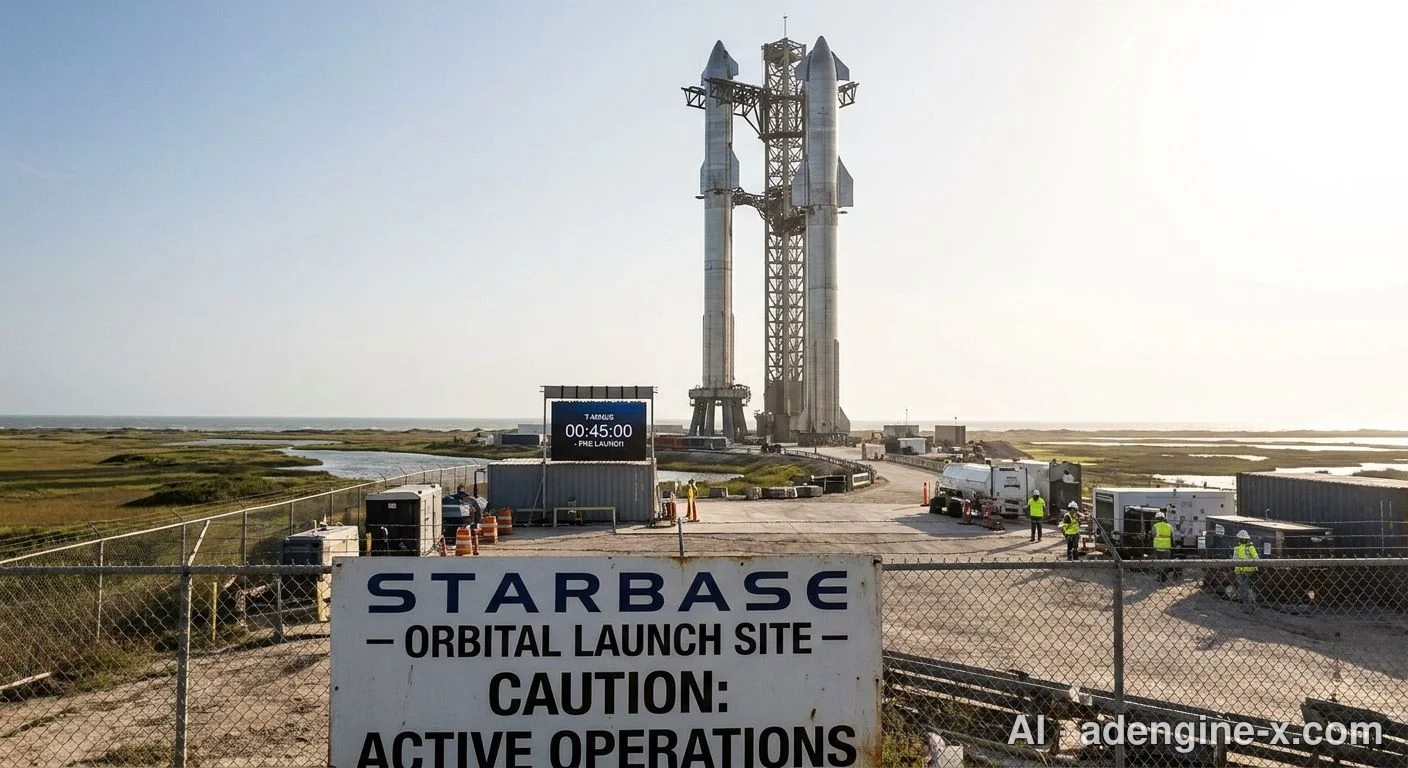
In the intermediate term, no operational catalyst carries more consequence than the upcoming Starship Flight 14 test campaign from Starbase, Texas. To validate the core inputs of Pivotal Research's $220 target and Oppenheimer's $280 thesis, the engineering team must demonstrate continuous, commercial-grade booster capture using launch-pad mechanical arms (‘Mechazilla’), followed by the controlled atmospheric reentry and precision soft landing of the upper stage ship. Until both flight stages achieve repeatable, low-maintenance reusability, payload transportation economics will remain structurally higher than long-term equity projections assume.
The Maiden Public Quarterly Earnings Filing
Finally, the release of SpaceX's first comprehensive public quarterly earnings report, scheduled for late November 2026, will force Wall Street to reconcile models with financial statements. Analysts will scrutinize whether Starlink's average revenue per user (ARPU) is expanding across enterprise channels, whether the operating losses of the xAI software unit have begun to moderate, and whether consolidated gross margins confirm the operating leverage necessary to sustain an enterprise valuation exceeding $1.9 trillion.
SpaceX remains one of the most ambitious corporate experiments ever listed on an American stock exchange. For long-term investors, the opportunity to own the physical gateway to orbital infrastructure is compelling. However, with the stock trading 11% above its $135 IPO price against a backdrop of historic capital expenditures, balancing multi-planetary ambition with disciplined fundamental valuation remains essential.
ℹ️ This article was drafted with the help of an AI tool and reviewed/edited by a human before publishing. · Original: AdEngine-X
📚 References
This list may include both live search sources the AI referenced while writing and public-data sources checked during fact verification. Please verify the original sources before citing or reusing.
0 Comments
Loading comments...